
June 30 2017, 23:24

Forming an objective view of the state of affairs in your world is simple: imagine that there is no mass dissemination of information. No newspapers, magazines, TV, internet, Facebook. There are people in your circle – parents, friends, neighbors, and your impression of how they live, and your experience in how you live. Well, it is assumed that they also don’t have access to the list mentioned above. And through the prism of this set of impressions, one can try to evaluate whether we like the world around us and whether we want to change it.

“In your world” is not by chance. It’s impossible to understand how the hypothetical Saratov lives from Moscow’s perspective.

June 28 2017, 10:04

We have a store here where all the prices are twice as high as usual, and yet it’s insanely popular. Why? Because hardly anyone buys anything expensive at full price. But people still buy, and that’s what the business model relies on. The store is called Michaels. In Russia, the closest equivalent in terms of assortment is “Leonardo”.

In the USA, you can almost always find a 50% coupon at Michaels – though true, it’s one coupon per bill, but you can select the most expensive item, and unfortunately, buy the rest at full price. But you can go either with a partner or in a small group, or even enter the store a couple of times. Every receipt gives 25% off on the next purchase. Thus, with a bit of savvy, you can buy everything for less than half the price tag. But! There’s a ton of little things being sold that you’d want to purchase. Well, you come to the cashier with a basket, you won’t be ringing up a separate bill for each individual glue stick or pencil.

There’s a ton of people who don’t bother with coupons. “They’re above that” πŸ™‚ As a result, it results in an interesting model: the store effectively has two prices: for the casual/wealthy and for the prepared/economical shoppers. I think that the first group is quite large, although it feels like everyone here uses coupons.

June 27 2017, 18:47

It’s interesting how Google works: if you search for site:http://domain/folder1/folder2/* it shows 85 results, none of which include http://domain/folder1/folder2/folder3/folder4/file. This somewhat implies that this URL does not exist on Google at all – I clicked through all ten pages of results. But not at all – it does exist if you request it directly. If you type in site:http://domain/folder1/folder2/folder3/folder4/* it brings up this URL.

June 26 2017, 04:45

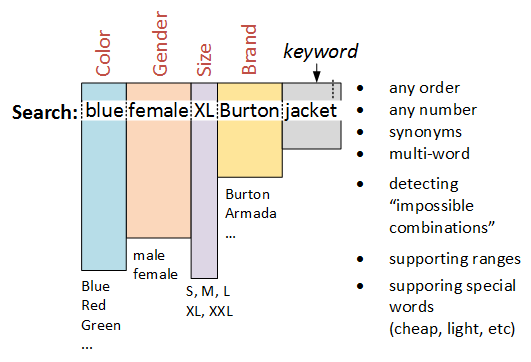
Published an article about Concept-aware search: recognizing facets in a query. Inside, there’s a demo showing the difference between how default search works and the same search but with my logic on top. It’s called, feel the difference πŸ™‚

The idea is this: if you are searching for something with the query “red dress size 39”, you should not be shown products with all these words in the description or title, but products filtered by the tag “red”, “dress”, and “size 39”. For the Russian language, it will still require some more work, while it already works for English.

Welcome!

June 25 2017, 20:50

Please help me come up with a name) I’ve created a search prototype that automatically sets facets. For example, when searching for blue armada jacket XXL, it actually searches by the keyword jacket, and the other three words are used for facets (color=blue, brand=armada, size=XXL).

The rough draft name is Automatic Search Facet Discovery, but I’m worried it could be confused with automatically creating facets based on content during indexing.

Google searches don’t yield any articles or products, or maybe I’m just not searching well.

Perhaps somebody has some thoughts?)

June 23 2017, 17:45

How far technology has come πŸ™‚ I’ve been having some battery issues, went on Dell’s website, it suggested I download a diagnostic tool. The diagnosis came back with “Battery’s bad, we’ll send you a new one for free, your laptop is under warranty, all good. Enter your address.” I did. Now waiting for the new one. I’m not used to this kind of service. Normally, you have to go somewhere and prove something to someone.