October 23 2017, 18:30

I just received a note from school on which I found an interesting grammatical structure “if school _will_ close early, the announcement _will_ be made…”. We were always taught that there cannot be future tense after if. I know about three exceptions:

1) if if is used in the sense of “whether” (“Doctor, can you tell me if my hamster will have babies?”)

2) if will is used to express willingness (“I think I will warm some water for tea if you will excuse me.”)

3) if the part in if happens time-wise after the part in then (easier to show with an example: “If aspirin will ease my headache, I will take a couple tonight instead of this horrible medicine.”)

P.S. Thank you, I missed something, there really is the third case here. First comes the announcement, then the school closes. I somehow thought it was the other way around, didn’t grasp the meaning) Generally, a good illustration of the third point

October 23 2017, 16:59

Unbelievable, there’s a decent page on TripAdvisor about Syria. Things to do, hotels, daisies in the field, spa in Aleppo. I guess it should be comprehensive.

And then I stumbled upon a report – one daring Norwegian took a tourist trip there for a week, returned three days ago with photos and impressions. He shares the ins and outs. Next time you watch the news on TV, remember

October 22 2017, 21:30

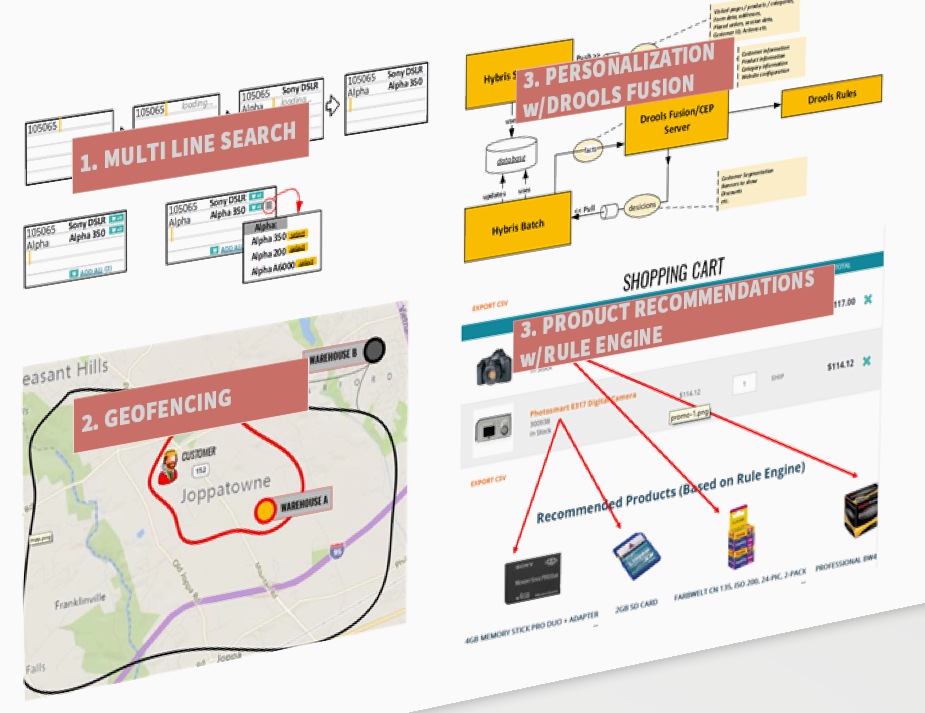
Published the fifth part of the video presentation at SAP Moscow on September 29. In it, I discuss four topics:

– Multi-line search. A handy feature for b2b sites. You can search and order products without leaving the search bar.

– Geofencing (this is when you can draw areas on the map and link them with delivery times and costs)

– Personalization using the external event processor Drools Fusion. Allows you to find patterns in user behavior and modify the site based on these patterns.

– Recommendations using Drools and Rule Engine. Allows the use of rules to build upsell/cross-sell recommendations.

Overall, this is not so much about Hybris as it is about universal solutions applicable to all platforms. So, even if the word “Hybris” means nothing to you, and you are thinking about how to make your e-commerce significantly cooler, the information from the video might be useful.

The video is available both in the Russian version (original) and in English (with subtitles and voiceover translation).

The next part should be the last, about caching.

</p

October 21 2017, 11:35

Reading Homo Deus about evolution, I’ve developed a hypothesis. What if ancient organisms had the ability to make elementary decisions about variability, and it wasn’t an absolutely random process? Obviously, I’m not talking about logical thinking in the first amphibians, but rather about a massive decision-making matrix regarding variability, inherent to them since birth, with parameters defined by various experiences. Ultimately, if the issue with pulmonary respiration is already resolved and walking on fins across the beach is inconvenient, the next generation “knows” it would be wise to change in this regard, and something slowly begins to evolve, so that hundreds of millions of years later on the same beach, it wonders why humans aren’t birds. If this is so, for millions of years of evolution, such a considerable part of the neural network in the brain must be filled with such rules, and, when needed, this mechanism neatly initiates variability in the right direction, not at random (well, as far as this neural network knows what ‘right’ is)

In the classical theory with random changes, I dislike that the probabilities of these changes are too small. Certainly, there are hundreds of thousands and millions of years for such random experiments, but it only works effectively in enormous populations with rapid reproduction. For example, when the entire world ocean teems with a single species rapidly reproducing, generations change quickly and the more adapted survive better than the less adapted. But what about species presented in significantly smaller numbers, and with a fairly long life. Well, I don’t know, take, for instance, an elephant. Does it mean that the elephant will evolve over the next million years (if we imagine life/elephants will exist that long – unlikely) just because it’s beneficial in a circus to walk on two legs? I think, with elephants, it might not work out.

And 100000 generations ago, we were still monkeys, for example, and about 10000 generations ago, humans were definitely not monkeys anymore.

If experience can be inherited, then what I write in the first paragraph might indeed exist. The only thing left to prove is that this decision matrix can be transmitted horizontally from species to species, and then everything would be quite beautiful.

October 20 2017, 13:33

I have always considered Moscow to be the safest capital in the world. Well, after visiting other capitals. Probably, it really is so. But I have also always thought that all cities smaller than Moscow significantly differ in terms of safety. For instance, walking at 1 AM in Balashikha is not safe.

During one of our recent nocturnal strolls, we noticed that we were not at all worried about our safety, even though we hadn’t come across a single person for an hour, only a few cars passed by, and in several places the lighting was barely enough to see where you were stepping. In essence, our walk around our office district somewhat resembled walking through an industrial zone: it’s mostly uninhabited because of all the offices, and generally, no one walks around (we met runners only a few times during dozens of hours of walks). By the way, none of the offices have people at night. The concept of security guards in the offices doesn’t exist; everyone heads home in the evening, and doors open with employee cards. In other words, if you wanted to call for help, probably only a passing car driver could hear you, but with the radio on, windows closed, and no common practice of this, it’s not something to count on. At best, a driver might call the police on their way home.

And yet, there is no crime. Well, that means, there is, but like this:

In the last month, near the house within walking distance, there were about three robberies in “near the metro” areas, but in the countryside (north of the image) there are no crimes at all.

I wonder how Americans manage to ensure safety in areas where everyone is relaxed and no ambush is expected? After all, for criminals, it’s easy prey and minimal risk. It’s puzzling. But somehow, it works.