
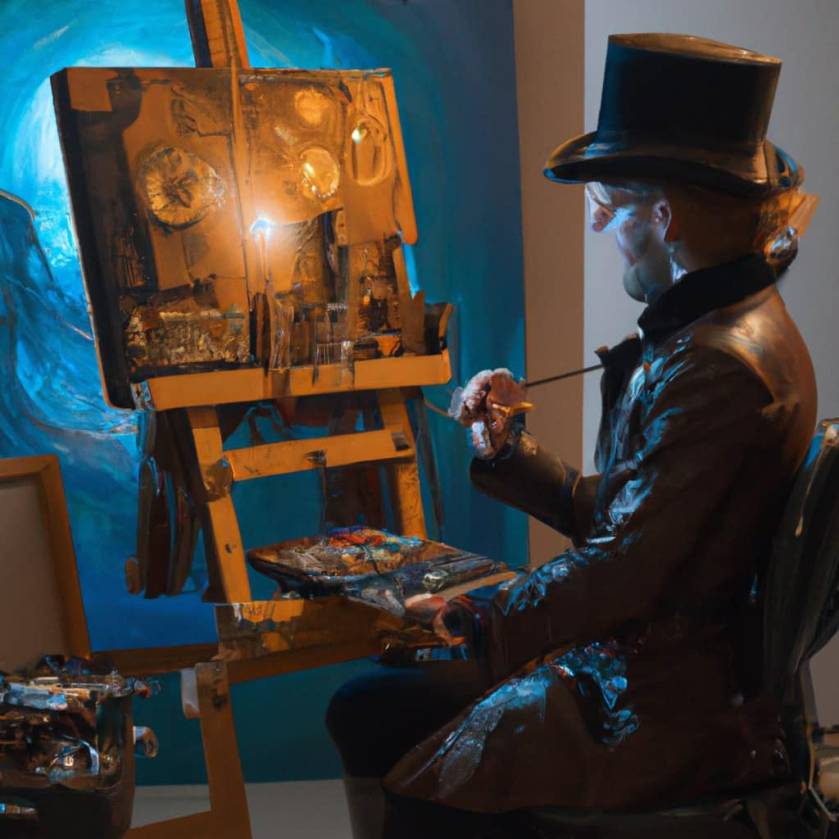
My 21st attempt at oil painting.
The Desolate Embrace

My 21st attempt at oil painting.
The Desolate Embrace
Here is a typical scene in our parts. If you see a cool car like in photo 1, then the driver and passenger will very likely look like in photo 2. This applies to the third purple Rolls Royce as well. Probably somewhere in Atlanta, a local rapper would be driving the Corvette, and the purple Rolls Royce would have undergone a bit of tuning.
And that’s really great. By retirement, many save up enough money to afford what they missed out on earlier. For some, it’s traveling in Europe; for others, it’s driving around the country in a cool car with their beloved grandmother.


Oleg bravely tackles everything
Everything turns to shit
And if he tackles shit
He just expends less effort

My 20th attempt at oil painting. Nadezhda Shulga for you with love!

Just published a new article where I explore the intriguing interplay between engineering and artistic pursuits, specifically painting and playing the piano. 🎨🎹 I dive into how these seemingly disparate activities enrich each other, enhancing skills that are crucial in both domains – from fostering an ability to think graphically to honing keen attention to detail.
Sometimes it’s worth trying to rationalize hobbies – although, probably, it’s a strange thing to do. But I have an engineering mindset, so please excuse me.
So, from hobbies, I can clearly identify painting (with oils) and piano. Everything else I do is extremely irregular, without any significant level, and doesn’t really deserve a mention.
If I have to choose between these two, then in terms of effort/result ratio or hours spent/skill level, painting is far ahead. In terms of money spent/skill level, at first glance, piano seems to be ahead (buy the keys once and that’s all), but in reality, ten hours of piano without a paid teacher is equivalent to an hour with a paid teacher, and without any teacher at all, you’ll quickly hit a “ceiling” that will be difficult to overcome, as wrong techniques are already ingrained. However, this ceiling is not exactly low. In painting, a paid teacher can be largely (about 90%) substituted by YouTube if desired. In piano, only about 40% can be substituted. After a year of daily piano practice, you can surprise your friends on Facebook, but a year of daily painting practice can reach a quite good level and even impress professionals. I still have eight months to go until a year, and I paint maybe once a week, so it will take longer in my case. Piano, with the same effort, would take forever. In other words, the piano learning curve is significantly more gradual.
What does painting provide? Why is it needed for an engineer? There are several reasons.
Firstly, the ability to think graphically. At a recent meeting, my colleagues complimented me for drawing a very complex and organically appearing functional system architecture diagram on the fly. I always thought this was a general skill, but it turns out it’s not. For many, it’s a separate type of work that requires focus, and during which one must think about layout and composition.
Second. I don’t know any other activity besides painting, or maybe sculpture, where the brain is loaded with an intense internal dialogue during the process. Programmers will understand me, but this only happens to you and I during rare cases of complex troubleshooting or writing a complicated algorithm in one go. In painting, it can’t be otherwise. Is this spot lighter or not? Are these lines parallel? Do these angles match? Where to shift the red – towards burgundy or pink?
In piano, there is none of that. But there is something else in piano that is absent in painting. In piano, you gradually learn to act ahead of the brain. There, decisions must be made before they turn into words and pass through the brain. Drivers will understand. But this is not about mechanical memory. That’s actually harmful. It’s about, for instance, playing a chord that’s not even sounded in the head yet, but follows the one that just entered the ears. The hands press on something, and then the brain catches up.
Third. Painting provides an interesting skill – paying attention to the distinctive features of familiar objects and forms. You look at a person, and their eyebrows and the lower lines of their cheeks form a neat X. Or a slightly raised bridge of the nose. Or a protruding chin. Or the shadows under the eyes. Or huge ears. For 90% of people, these are unimportant details that they overlook in everyday life. You start noticing that indeed there is a reflection in the shadow part. And that there is no pure white or black. And then it all starts catching your eye. Sometimes this is not a plus 😉
That’s why it’s interesting to learn something new. It opens new doors into how the world around us works. And this is something engineers should know and understand well, so that their work brings more pleasure both to them and to the people for whom they do their work.

“Parade participants in Moscow were given an evacuation plan from Red Square”

Interesting figures on global car sales for 2022.
The Toyota RAV4 holds first place. Tesla Model Y is third, following the Toyota Camry with a growth of plus 91%. My first car in the USA was a Camry, the second – a RAV4, and I think the Tesla Model Y will be just right for you 😉
Essentially, Toyota and Tesla dominate the top ten. Mercedes starts at 34th place with the GLC. It’s interesting to look at the tail end. Land Rover Range Rover is in 485th place.
Quoting the conclusions:
“Sales of new cars decreased by 2% compared to 2021, to 79.4 million units. In 2021: 80.7 million units.
The decline resulted from demand issues in the 2nd and 3rd largest markets in the world, US-Canada and Europe, as well as a slowdown in sales in China. These three markets made up almost 69% of the total global sales volume. These issues were linked to the lack of new cars available due to supply chain problems, and a shortage of semiconductors.
Another factor in the sales decrease was the war between Russia and Ukraine. The invasion of Ukraine and sanctions against Russia had a significant impact on sales, particularly for Russia, which was the 11th largest car market in 2021, but last year fell to 21st. Sales there dropped by 59%, or almost 1 million units.
Conversely, demand in India surged by 24% and reached a new high at 4.37 million units. An additional 851,000 units compared to 2021 allowed India to overtake Japan and become the third largest car market in the world. However, the total number of new cars sold per 1,000 residents remains extremely low at 3.1 units, the lowest among the top 25 car markets.
In Latin America, conditions improved thanks to a limited recovery of the Mexican market and better circumstances in Chile. Nevertheless, this region, the largest among emerging markets, still lags behind developed countries in terms of new cars per 1,000 inhabitants, recording only 7.7 units compared to 16 units in China, 21 units in Europe, and 41 units in the US and Canada.
Another bright spot in 2022 was the Southeast Asian-Pacific region. Indonesia nearly competed with Australia as the largest market in the region with double-digit growth. This was one of the results of rising economy of the country, increased international tourism, growth of private investments, and high consumer spending. Malaysia surpassed the 700,000 unit mark for the first time due to tax relief policies throughout the year.
Financial stimuli, measures, and incentives adopted post-pandemic boosted demand in the Middle East, where the six countries of the Gulf Cooperation Council accounted for 46% of the 2.75 million units sold. This region is expected to play a more significant role in the global automotive context as Saudi Arabia, the 19th largest automobile market in the world, aims to become a hub for car production.
The country’s sovereign wealth fund recently acquired key stakes in companies such as Lucid Group and Aston Martin. Investments in electric vehicle production are expected to reach $50 billion over the next decade.
Finally, sales volume in Africa grew by 5.5% to 1.15 million units thanks to a 14% increase in the South African market, the largest in the region. Sales in this country accounted for 44% of the total sales volume on the continent, aided by the recovery of tourism and travel, which stimulated the rental market. Sales in North Africa accounted for 42% of the continent’s total volume. South Africa accounted for 45%. East, Central, and West Africa accounted for 4.8%, 1.3%, and 6.7% of the total volume, respectively.
By the way, here is the same heron (fragment) captured with the telephoto lens of an iPhone 14 Pro Max and an iPhone 12 Pro. There’s a significant difference, although the sensor has barely changed and the optics are more or less the same. Apparently, images from other lenses are being mixed in.
iPhone 14 Pro Max (on the left) 12 MP, f/2.8, 77mm (telephoto), 1/3.5″, PDAF, OIS, 3x optical zoom
iPhone 12 Pro Max (on the right) 12 MP, f/2.2, 65mm (telephoto), 1/3.4″, 1.0µm, PDAF, OIS, 2.5x optical zoom


A heron, not a heron
Watches over us with Yuka


 Hi, I'm Rauf Aliev.