January 09 2024, 11:40

Before my next trip to Starbucks Reserve for coffee, I googled their logo. It turns out that Starbucks originally had a logo with a two-tailed mermaid with a belly, hairy hand, and, excuse me, with breasts. Then they styled it, grew the hair, but it still turned out to be somewhat odd. In the second picture, I suggest my own logo for Starbucks. I think it more fully reflects the name.

January 08 2024, 12:09

Here is my brief video review, probably of the coolest and largest coffeehouse in the world. This is Starbucks Reserve. The coffee there is obviously very tasty, just like everything else. I think they definitely don’t skimp on coffee, as the whole four-story gig probably operates at a major loss, and it’s by design. By the way, it’s a big question why Starbucks in the USA needs to invest in advertising. At the airport and in any small town, there are queues from morning that last half an hour, while alternative coffee shops operate with much shorter lines or none at all. But, probably, working on the brand image today ensures sales in the years to come.

January 07 2024, 13:32

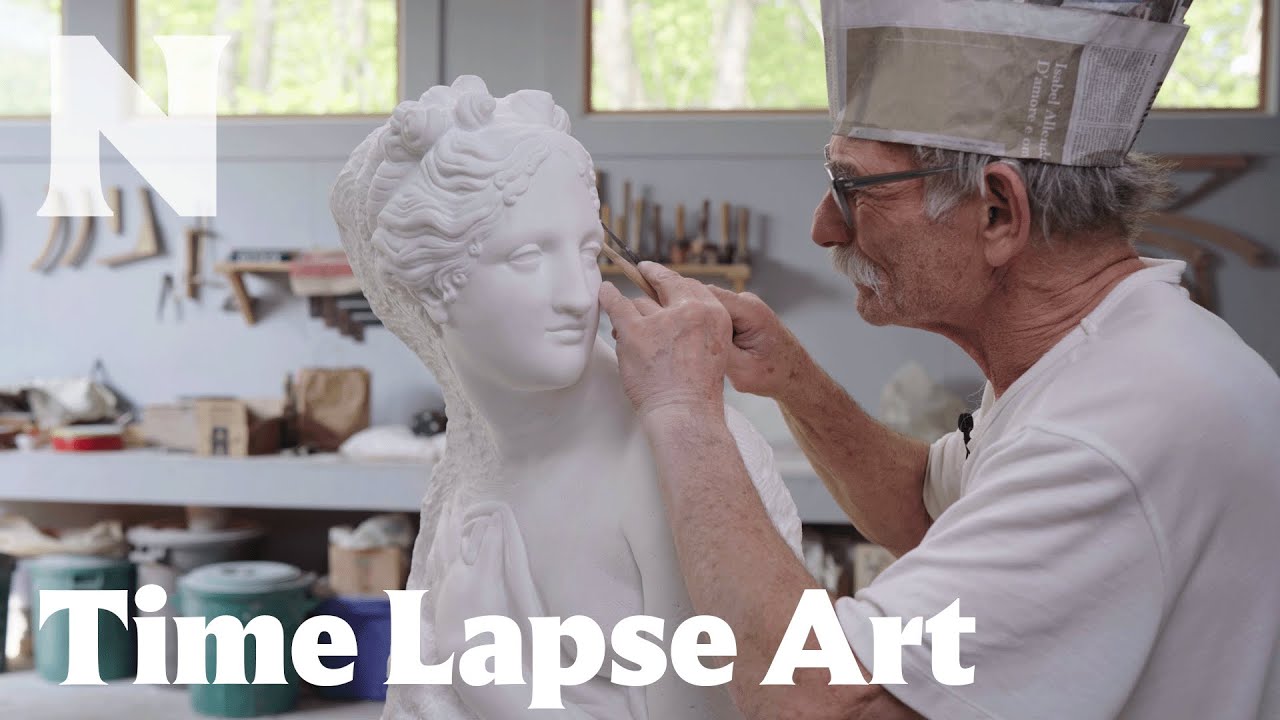
I’ve always been fascinated by how sculptors work. I am currently at the Canova: Sketching in Clay exhibition in Chicago, and there’s this short film playing amidst Canova’s sculptures. Found it on YouTube. In it, American sculptor Fred X Brownstein demonstrates the entire process of creating a replica of Canova’s Venus from sketch and clay model to plaster cast and marble. Quite mesmerizing.

January 07 2024, 08:39

Is there such a service where you enter a hotel, and it shows a price chart throughout the year, from which you can draw various conclusions like when it’s peak and off-peak seasons, how often the price drops, and whether it’s the right moment to book now or better to look for something else?

And the same thing for airplane tickets.

It would also be great to leave a request “I want to stay at this hotel, but not for more than $150”. Or for this destination, but I want to pay no more than $200 for tickets. And leave the dates open. And as a guarantee for the purchase, I’d place a hundred dollars on deposit. I can withdraw it with a 30-day notice. Let the service gather such requests and negotiate with the hotels

January 06 2024, 22:44

I recently started reading a very captivating book by Ed Yong, An Immense World: How Animal Senses Reveal the Hidden Realms Around Us (in Russian translation – Необъятный мир: Как животные ощущают скрытую от нас реальность). I want to summarize each chapter on Facebook to get a better grasp of the subject. Also, as a side effect, to entertain people, although I am doing this more for myself 🙂

I’ve just got hooked on a topic, and went online to dig up details. The topic is – why are there so few blue creatures? There are many red, yellow, brown ones, but few blue ones. It turns out, it’s even more interesting—there are practically no animals with blue pigment. But it’s curious that it’s not “none,” but “practically none”. Interestingly, the same nearly holds true for green.

Let’s start with what a pigment is. Pigments are substances that physically absorb certain wavelengths of light and reflect others, which determines their color. For example, a pigment absorbing red and green light will appear blue. But most likely all the blue you see on animals is not the result of blue pigment. It’s the result of a special physical structure of the surface. These structures are microscopically small and manipulate light through diffraction, interference, and scattering. As a result, the color appears bright and sometimes changes depending on the viewing angle. For example, peacock feathers do not contain blue pigment, but thanks to microscopic structures, they reflect blue light. Pigments work through chemical composition, while structural colors through the physical structure of the surface.

So, everything that comes to mind as blue—butterflies, peacocks, birds like blue jays, blue spiders, blue sharks—none of them have blue pigment. But there are interesting exceptions. For example, the butterfly obrina olivewing has a natural chemical blue pigment in its wings.

You might ask, what about blue eyes? The trick is that blue eyes don’t really exist. Generally, humans have several important pigments that mix to give new colors. For instance, the main pigment, melanin, determines the color of the eyes (and skin, and hair). It comes in two main types: eumelanin (which can be black or brown) and pheomelanin (which gives reddish-yellow hues). So, blue eyes are those without any melanin. The blue color of the eyes is formed by a combination of structural color and the absence of melanin pigment in the front part of the iris. Here, a phenomenon known as Rayleigh scattering also plays a role, which also accounts for the blue color of the sky. The light scatters in the tissues of the iris, with shorter waves of light (blue and green) scattering more than longer wavelengths (red and green). By the way, it participates in the green color of the eyes too. Humans and animals do not have green pigment. The green color in animals is often the result of a combination of yellow pigment and blue structural coloring. In other words, almost all natural life primarily consists of a combination of black/brown/reddish-yellow (melanin), red (hemoglobin), yellow-orange (carotenoids, bilirubin). That’s why earthy paints—sienna, umber, ochre—are often used in portraits. Speaking of carotenoids – flamingos are actually born gray, but because they eat small red crustaceans containing carotenoids, they acquire a pink color.

Speaking of beautiful butterflies. It turned out that butterflies actually barely see each other as we see them. I mean, they almost don’t see everything clearly. Unlike the human three-color retina (blue, green, and red cones; plus rods) and honeybees (ultraviolet, blue and green photoreceptors), the retina of butterflies usually has six or more classes of photoreceptors with different spectral sensitivities. I attached a picture from the book—how a flower with a butterfly on it map butterfly sees a reed bunting and a Eurasian blackbird. There are convincing reasons to believe that butterfly vision is almost non-existent. But what they do have is very, very specific and probably just one component of the olfactory picture of the world. So all this beauty on their wings—it’s not even for each other. It’s sort of a side effect. That is, evolution selected for large spots, but all sorts of small patterns just went along for the ride.

Oh, also about the perception of colors. I attached a picture of how the Himba people of African ethnicity perceive colors. They don’t immediately notice the blue square on the right side, because their language uses the same word for blue and green. But they have no trouble distinguishing the square encircled, because from childhood they are trained to discern this difference and they have two words designating them in their language.

Anyway, if you’re interested, I’ll keep writing stuff like this. It’s quite simple for me to do, and generally interesting to Google more about what I’ve read than the book goes into.

January 06 2024, 16:51

Today, Masha and Nadia became U.S. citizens! The ceremony could, of course, have been a bit more pompous. Some people have been striving for this day much longer than us; I wouldn’t be surprised if there are those who have waited for about twenty years, and whose journey included hardships and working for an exploitative company sponsoring their “green card.”

The process involves a five-year residency period known as a “Green Card.” It is obtained either through a lottery or through company sponsorship — the latter is my case. The duration to obtain the “green card” can range from one and a half years (my case) to forever. Those coming from India, the Philippines, China, Mexico might wait 10 years, and during this time, they must work for the sponsoring company. If they quit, finding a new sponsor is definitely more difficult than just finding a job. After five years with the “green card,” you can apply for citizenship. It’s “can,” not “must.” The Green Card can be renewed indefinitely. One downside is that you’re still a guest, and if the state has a reason to ask you to leave, mechanisms exist to do that. True, such reasons include, for example, serious violations of the law. But who knows, in general, people without citizenship but with residency status are somewhat vulnerable.

With citizenship, the whole world opens up, as the American passport opens doors to many countries (about 180).

There is a view that taxation becomes more stringent upon obtaining citizenship — if you work, say, in Brazil, you have to pay taxes in both Brazil and the U.S. That’s actually the case even without citizenship. If you hold a green card, yes, you must pay taxes in the U.S. even if you do not live there. However, if you’re abroad for more than six months a year with a green card, that may be enough for it to be taken away. So, the main difference is that with a green card, in the event of a violation of tax law, you can weigh the benefits and, if needed, wave goodbye to America from, say, Brazil, without paying anything on those earned hundred million. True, afterwards, getting a visa might be difficult, but when you’ve made a hundred million there, maybe you wouldn’t need it anymore. With citizenship, this won’t work. The same Brazil, upon request from the U.S., will find and deport you. And they will take and split those hundred million.

Yes, some also asked about the documents — citizens and permanent residents don’t really differ in their “everyday life” documents. Roughly speaking, the hotel has no idea whether you are a citizen or just some guy who came on a visa and works here. Also, unless specifically asked, you wouldn’t know the status of someone on your team. (Well, apart from the fact that it’s improper to ask such questions, it’s also unclear why one would need to know.)

Congrats to Nadia and Masha, Lisa’s turn is coming up soon too 😉

January 04 2024, 11:44

8 years in one place! That’s crazy, I used to start looking for something new after just 2-3 years. But it’s because at EPAM it feels like you’re changing jobs (=projects) every few years or even more often, only the badge remains the same. Maybe the title gets upgraded, too.

Ultimately, over these eight years, I essentially worked with the world’s biggest niche e-commerce businesses. These are worldwide businesses with millions of products and massive traffic, usually brands that everyone knows. Probably, there are about three that are the largest, plus many smaller ones that are well-known in their field.

In essence, each project is like a separate job. There’s a distinct team, only partially consisting of EPAM colleagues, its own technologies, its own know-how. Typically, I am involved in two roles on such projects — Solution Architect and Senior Java Developer / Team Lead. I’ve largely moved away from management, retaining only the part that falls under Team Lead.

Formally, my current title is Chief Software Engineer L2. I transitioned into this from Solution Architect because over time I realized that I was slightly uncomfortable in the SA crowd: too much about diagrams and not enough hands-on. You occasionally meet SAs who barely understand what’s under the hood, or understand it in theory only (though sometimes well). But the position itself doesn’t really decide much. It can’t be completely ignored because it somewhat ties to the salary, but in general, what I do matters to me more than what I am called.

Essentially, I am now drawing the same diagrams and discussing the same solutions, but in between, I dive into tons of Java Spring code (including or not including SAP Commerce Platform) and periodically contribute to it. Every now and then, I have to puzzle over various borderline things between programming, networking, and server administration in a cluster.

Our company just turned 30 years old. It’s nice to see that things are going very well, and even known problems have been survived without major losses. The company has fully recovered, moved everyone who needed to be (and could be, and wanted to) to safe places. Work continues.

In general, thank you #EPAM