
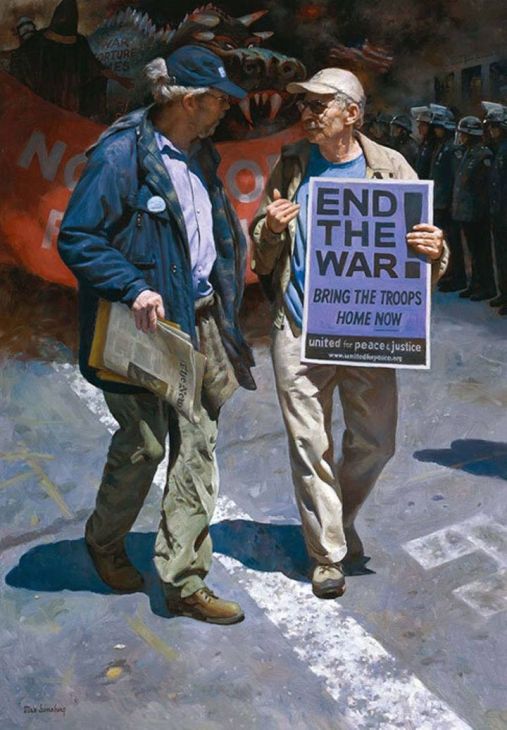
Today, meet Max Ginsburg. He paints the everyday life of New York streets. His works vary greatly in mood, but notice that they all have the same “signature.”
It’s a fascinating exercise to find common elements in different works by the same artist. Not in the sense that if everyone, including women, looks like Putin, it’s Jan van Eyck; if there are huge backsides, it’s Rubens; if you see an Excel sheet with colored areas, it’s Mondrian, etc. But rather in the technique, brushstrokes, color, how contrast is conveyed, and so on. Unfortunately, these nuances are not always visible in digital reproductions.
I’ve long sought an engineer’s answer to why visit museums when everything is available online. Of course, someone who visits museums willingly probably doesn’t ask this question anymore. But still, let me explain. In past centuries, painting techniques often included the use of opaque pigments to create a monochrome underpainting (grisaille), over which layers of transparent colored glazes were applied (a varnish diluted to transparency with a lacquer-based medium, slightly tinted with pigments). This achieved depth of color and subtle transitions. The result was something like a very thin colored glass over a monochrome image. Light falling on it would reflect within this layer and become tinted. Such an effect can’t even be closely replicated in a photograph or on a computer screen.
Max Ginsburg’s technique doesn’t fall into this category, but his work conveys something no photograph can. And yes, his painting is very American. That too is part of his recognizable style.
Remember, similar posts are grouped under the tag #artrauflikes, and all 87 can be found on beinginamerica.com in the “Art Rauf Likes” section (unlike Facebook, which forgets about almost half of them).




 Hi, I'm Rauf Aliev.