
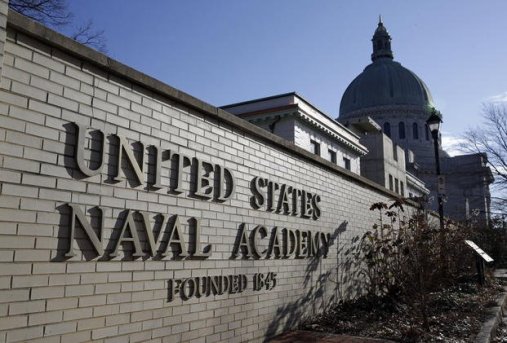
Last weekend we drove to Annapolis, which is about a 1.5-hour drive from our house. There you’ll find the Naval Academy – the U.S. Naval Academy (USNA). They train officers for the Marine Corps and officers for the U.S. Navy there.
Anyone with an ID is allowed on the grounds. They don’t photograph your documents or log them anywhere, but the area is certainly equipped with high-resolution cameras, so there’s no need for such measures. The territory includes educational buildings, dormitories, sports facilities, administrative buildings, historical monuments, and memorials. You can enter almost anywhere, and on Sundays in the summer, it’s almost deserted. You can wander around the floors of the educational buildings, see theses with formulas on the walls, almost all classrooms are open. No doubt the vigilant security is monitoring curious visitors through cameras, but still, the openness is quite striking. In total, we met at most a dozen other tourists, and this on a 137-hectare site. I don’t know whether few people know about it or everyone has already visited.
On one of the floors, for example, I found a pool for testing underwater robots. This pool, equipped with 40 surface and underwater motion capture cameras (Qualisys Oqus 7+), can pinpoint the position of the tested object 300 times a second. And there are many such laboratories there, I didn’t photograph everything (don’t know why). For instance, I discovered a planetarium in one of the rooms. A regular classroom door, and inside there’s a dome ceiling and a retractable robotic “head”.
In the courtyard, there was something happening that I jokingly called “yoga for sailors.” It was also worth recording, but somehow felt awkward to do so. On the field, a group of cadets in branded white sport suits sat in a precise grid, each with a bag and water beside them — all uniform, logos of the academy visible. The leader was shouting through a megaphone “two, three, four,” and after each count, the cadets responded “two sir! three sir! four sir!” and on each count, they synchronously did something, like jumping, or some kind of stretching. On the side stood three people with limited mobility, someone on crutches, someone in a cast, participating as best as they could.
And it’s still the summer, the campus is half-empty. Apparently, some kind of preparation for the main academic year.
The academy is waterfront, and understandably, there are many yachts around, including training ones. Sea wolves in training, so practice is essential.
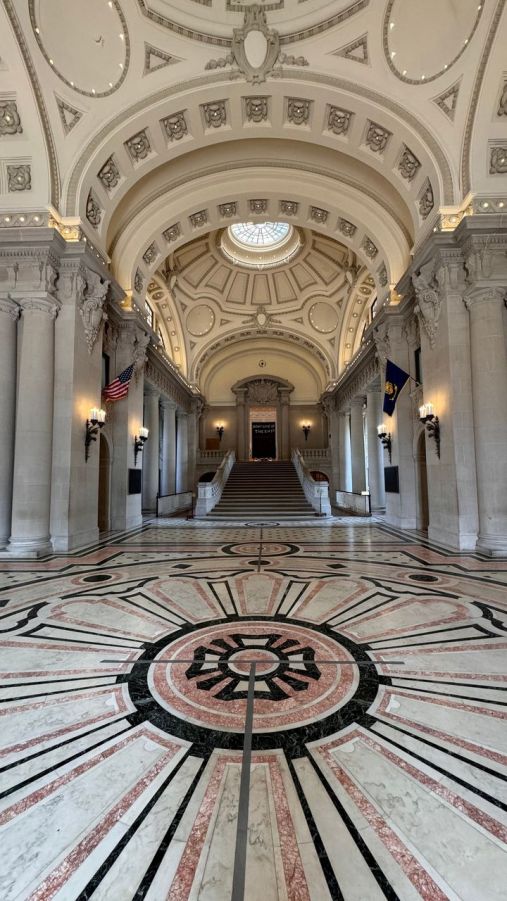
Everything on the campus is impeccable. Despite the academy being state-run, every detail screams “this is a prestigious place where no expense is spared.” It’s interesting that getting into the USNA is not so straightforward.
Admission to the USNA is a complex and multi-layered process, involving several stages. Candidates must secure a nomination from a member of the U.S. Congress, the vice president, or the president. This stage involves writing essays, interviews, and extensive preparation. In addition to the standard application, it is necessary to provide SAT or ACT scores, academic grades, and recommendations. Additionally, candidates must pass a physical test (Candidate Fitness Assessment), which includes running, push-ups, pull-ups, and other exercises, plus a medical examination. In general, it’s a tough process that also involves members of the United States Congress. Fascinating.






 Hi, I'm Rauf Aliev.