
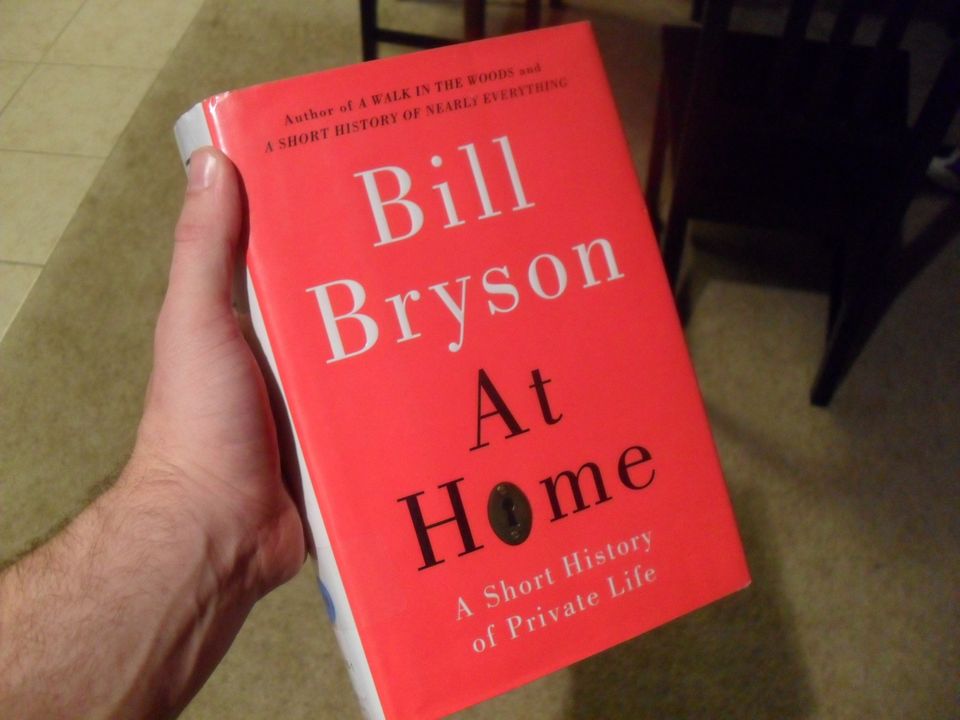
I’m reading At Home by Bill Bryson. Every so often, he hurls at me so many unfamiliar words in one sentence that there are hardly any familiar ones left.
Ptarmigan, sturgeon, larks, hare, woodcock, gurnet, barbel, smelts, plover, snipe, gudgeon, dace, eels, tench, sprats, turkey poults and many more largely forgotten delicacies featured in Mrs Beeton’s many recipes
Jefferson and his contemporaries enjoyed tayberries, tansy, purslane, Japanese wine berries, damsons, medlars, seakale, screwpine, rounceval peas, skirrets, cardoons (a thistle), scorzonera (~salsify), lovage, turnip-cabbage, and scores more that nowadays are encountered rarely or not at all.
These treasured concoctions could involve any number of ingredients – beeswax, bullock’s gall, alum, vinegar, turpentine and others even more startling.
Pepper accounted for some 70 per cent of the spice trade by bulk, but other commodities from further afield – nutmeg and mace, cinnamon, ginger, cloves and turmeric, as well as several largely forgotten exotics such as calamus, asafoetida, ajowan, galangal and zedoary – began to find their way to Europe, and these became even more valuable
Nineteenth-century pattern books offered homeowners an almost infinite array of shapely, esoterically named motifs – ovolos, ogees, quirks, crockets, scotias, cavettos, dentils, evolute spirals, even a ‘Lesbian cymatium’, and at least two hundred more – with which to individualize projecting surfaces of wood or plaster, and Mr Marsham chose liberally, opting for bubble-like beading around the doorcase, fluted columns at the windows, ribbony swags fluttering across the fireplace breast and a stately show of repeating demi-hemispheres in a style known as egg-and-dart around the ceiling trim.
Here’s something else interesting:
Although he is hardly read now, Horace Walpole was immensely popular in his day for his histories and romances. He was a particularly adept coiner of words. The Oxford English Dictionary credits him with no fewer than 233 coinages. Many, like ‘gloomth’, ‘greenth’, ‘fluctuable’ and ‘betweenity’, didn’t take, but a great many others did. Among the terms he invented or otherwise brought into English are ‘airsickness’, ‘anteroom’, ‘bask’, ‘beefy’, ‘boulevard’, ‘café’, ‘cause célèbre’, ‘caricature’, ‘fairy tale’, ‘falsetto’, ‘frisson’, ‘impresario’, ‘malaria’, ‘mudbath’, ‘nuance’, ‘serendipity’, ‘sombre’, ‘souvenir’ and, as mentioned a few pages back, ‘comfortable’ in its modern sense.
 Hi, I'm Rauf Aliev.