
Finishing Bill Bryson’s At Home, I discovered that originally, around the year 1540, it was a word for fabric, a diminutive of “toile,” which is still used to describe a type of linen. Then, it came to denote fabric used for a dressing table. After that, the items on a dressing table (hence “toiletries”). Subsequently, the word came to mean the dressing table itself, then the process of dressing, then receiving guests while dressing, then the room for dressing, then any personal room next to the bedroom, then a room used for sanitary purposes, and, finally, the toilet itself. This explains why “eau de toilette” in English and French can mean both something women enjoy applying to their face and simultaneously “toilet water.”
Interesting note on the word “wardrobe,” exactly as garderobe. It was a combination of “guard” (“to keep”) and “robe” (“clothing”) and initially meant a storeroom, then any personal room, briefly (and briefly only) a bedroom, and finally, a toilet.
The “water closet” (WC) appeared in 1755 and originally designated a place where royal enemas were performed. From 1770, the French called the home toilet “un lieu à l’anglaise” (“an English place”), which might explain the origin of the English word “loo.” Online sources say that loo comes from “gardez l’eau,” meaning “watch out for the water,” as it was shouted before emptying chamber pots out the window.
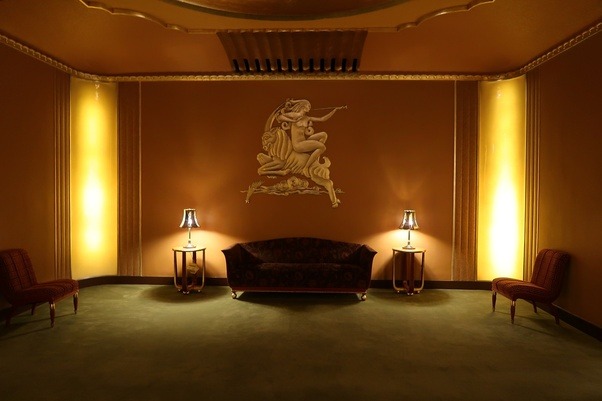
Here in the USA, toilets are called restrooms—a true Americanism. I just googled that in the first half of the 20th century, many American workplaces and public buildings had rooms with chairs or sofas that employees or clients could use to take a break, sit down, and rest. In some jurisdictions, laws were passed requiring these restrooms to also have toilet facilities. In everyday life, people who didn’t have the time to sit on a sofa and relax still entered the restroom to use the toilet. Over time, the expression “I’m going to the restroom” became synonymous with using the toilet or sinks, rather than chairs and sofas. Even as rooms with sofas became less common, the phrase with its new meaning persisted. Thus, a room with toilet facilities came to be called a “restroom.”
Of course, we can also say bathroom, without, of course, expecting any actual baths there.
The photo — a restroom from the 1930s.
 Hi, I'm Rauf Aliev.