
I just found out that IBM used to manufacture mechanical typewriters, which a) had a Backspace key b) featured a moving print head.
The 1984 model is called IBM Correcting Selectric III. It has an intriguing way of deleting a letter – it strikes the paper with a special adhesive tape that removes the ink without a trace.
Interestingly, in 1976, the USSR developed a keylogger for American typewriters and somehow installed them in the typewriters at the US Embassy. It is reported that many secrets were uncovered this way.
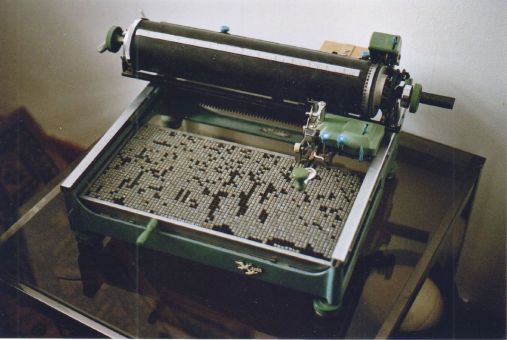
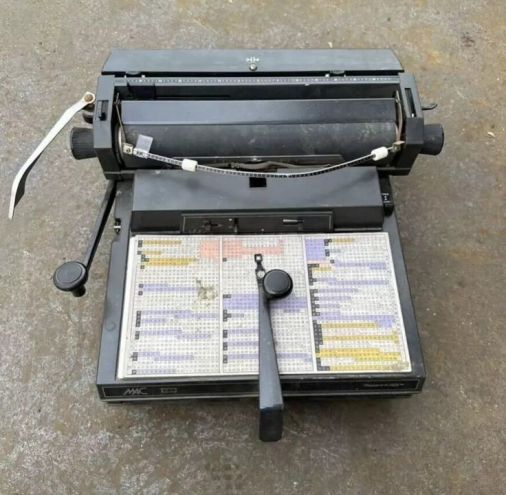
I was also curious about how they managed with this in Japan and China. Their typewriters don’t have a thousand buttons. Believe it or not, they have a single button. But. A thousand squares where they aim the “sight”. Well, I mean, there are different kinds, also like usual ones, but there are models where it’s like this (attaching a few photos). There is even a model with a cylinder that holds 2400 Japanese characters, and you need to rotate and shift the cylinder for each character. I’ll leave a video in the comments. A very elegant engineering solution.
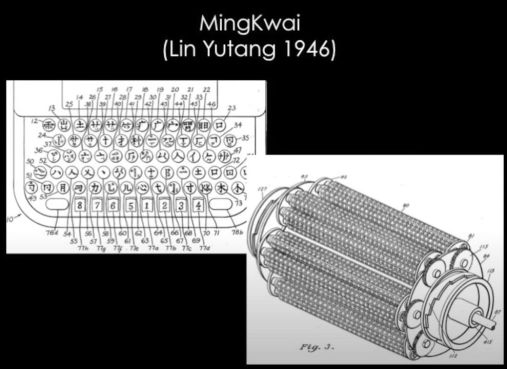
Moreover, in 1947 in China, the Mingkwai typewriter was invented and released, which theoretically allowed typing up to 90,000 characters at a speed of 50 characters per minute. Imagine what an engineering feat that was for the time. You press a key – nothing happens, something clicks inside the typewriter. You press a second time – something else clicks, but this time options that meet the criteria set by those two presses appear on the screen. And the third press essentially selects one of these characters. Meanwhile, the screen… what screen in 1947… It was a window through which characters from a large set were displayed. One character – three presses.
Only today did I realize that the Shift key is called Shift because it physically shifted the basket on typewriters. And while I’m at it, I’ll write about the Return or CR key – carriage return (known as Enter), which is so named because it physically returned the carriage to the beginning of the line. And the underscore (_) was invented to underline previously typed words.
It’s also interesting that the QWERTY layout was dictated by the need to spread frequently consecutive characters further apart to prevent the levers from crashing into each other during fast typing.
My introduction to typewriters in childhood, it seems, began with electric ones, although, of course, I also typed on mechanical ones. Interestingly, Friedrich Nietzsche’s encounter with the typing machine also started with electric ones. I read that he had the first shrivekugel.
In New York, I once saw a store (the only one I know of) that still trades typewriters.
Another interesting fact: when Edwin Hunter McFarland was developing a typewriter for Thailand, he ran out of keys for two consonants (“ฎ” and “ฅ”), and ultimately they disappeared from the language.
Also interesting is that the record for typing speed of 216 words per minute was set 78 years ago by Stella Pajunas-Garnand on a typewriter. In 2005 Barbara Blackburn came close (212 wpm), and in 2019 Anthony “Chark” Ermolin broke the record (233 wpm). Interestingly, such championships are organized by the company daskeyboard, I have two keyboards from them at home and am thinking of buying a third (by the way, has anyone bought one recently?)
In the comments, links to various things from ^^^^



 Hi, I'm Rauf Aliev.