
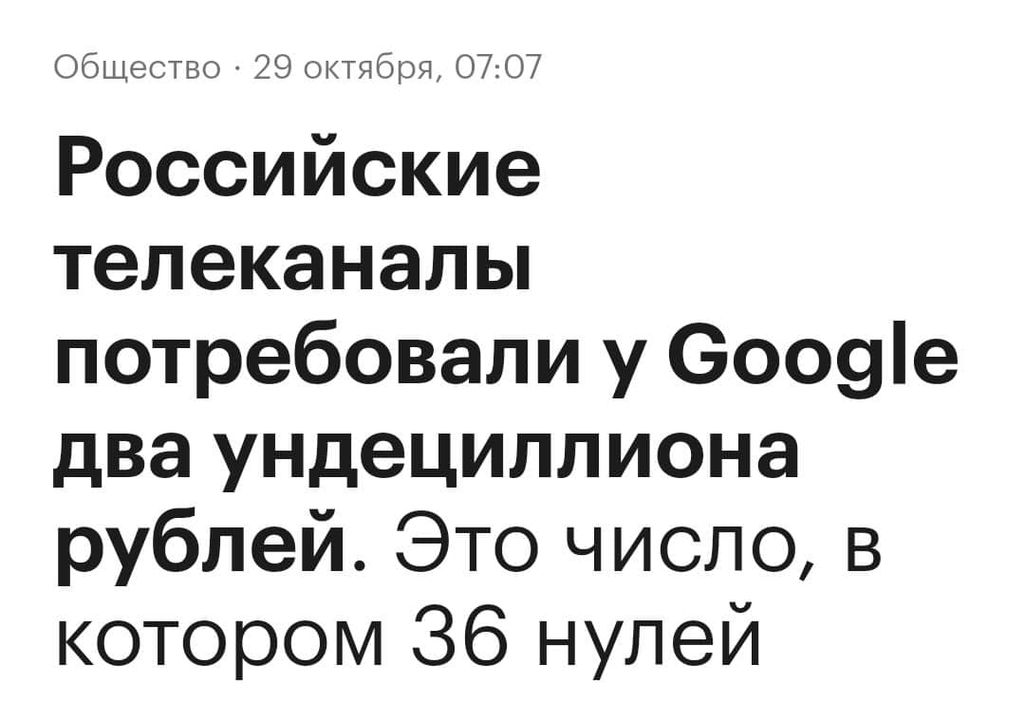
Russian TV channels have demanded two undecillion (2*10^36) rubles from Google. But what amused me was something else — technically, Google, or rather Googol, stands for 10^100. So, they’ve got plenty left in reserve.
But it was also interesting to learn that for large numbers there are two different systems of nomenclature. They diverge starting from billion, which in one system is 10^9 (equivalent to a milliard in the other) and in the other system it’s a trillion, which is 1000 times more, and this trillion in the second system means quintillion in the first, and so on, ultimately making the undecillion of the first system equivalent to sextillion in the second. It’s quite a mess, really.
The complexity is further increased by a third variant, called “the first, but not quite” — with the amendment that 10^9 is still considered a milliard, not a billion.
Different countries historically use different scales. The first, which is called the short scale, has primarily been adopted in English-speaking countries. In their scale (thus, ours) — 10^9 is a billion. In the Arab world, it’s generally a milliard (مليار), like in Saudi Arabia, it’s a billion (بليون).
Russia is also among those using the short scale. Hence, they demand an undecillion from Google, not a sextillion.
The second scale, which is long, is used by the Danes, French, Germans, Portuguese, and Spanish. For them, 10^9 is called a milliard with adjustments for pronunciation and grammatical representation in the language.
And then there’s a slew of exceptions, including countries that don’t fit into either of these two “camps.”
But what’s even more interesting is that until 1974, Britain called a billion a milliard, a trillion was known as a billion, and a quadrillion as a billiard. In 1974, they officially switched to the short system.
Canada faces the toughest situation. There’s already confusion with units, and the big number systems add to the mix. Officially, it adopts the short system, like the US, but due to bilingualism (English and French) and significant cultural influence from France, you might occasionally encounter the long system. South Africa is in a similar situation.
Curiously, the only article about this in French (and it says sextillion!) — is from RT. No one else in the world seems to care about this stuff. 🙂


 Hi, I'm Rauf Aliev.