
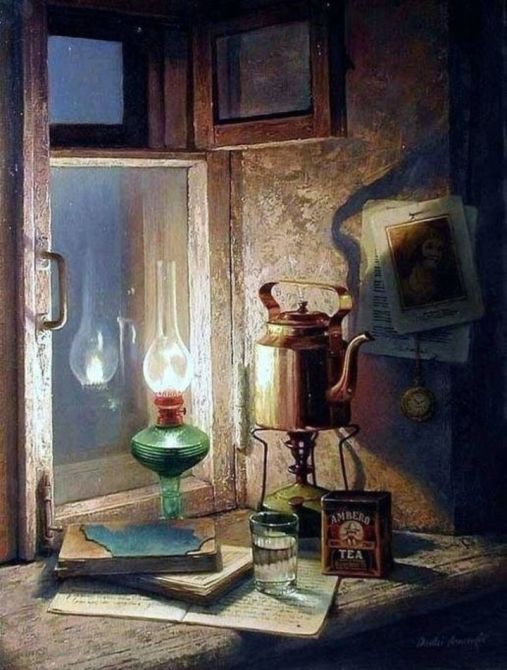
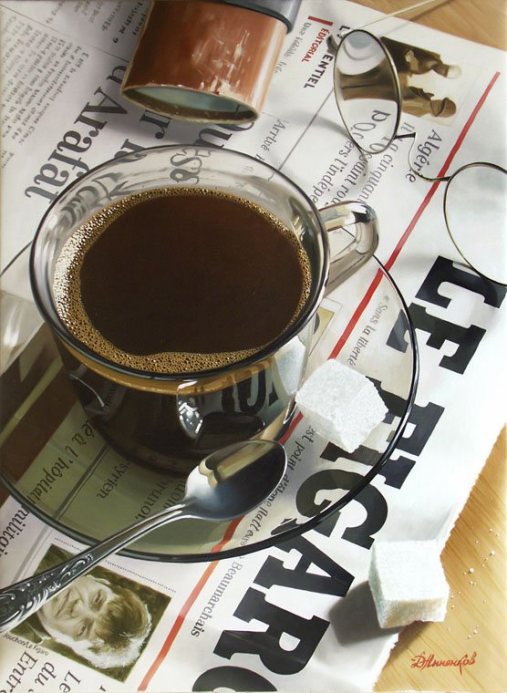
Today’s spotlight is on the works of Russian hyperrealist Dmitry Annenkov. How one can fit so many minute details onto a 40×60 cm canvas is beyond me, but if the Dutch painters managed it back then, why not now? That’s one way of looking at it.
To be honest, I’m not much of a fan of hyperrealism, because I’m left wondering: what’s the point, when we already have photography? Hyperrealism might give the impression that, if you select the precise color from a photograph using a colorimeter and apply it exactly to each millimeter of the canvas, with enough time, patience, and perhaps a bit of automation (like a canvas printer?), you’d end up with something close to what Annenkov creates. With more automation, you could churn out a painting a week. That’s why I find it far more intriguing when the mind has to fill in the gaps itself. Here, there’s nothing missing; the brain just ends up bored. Even watching the process would be interesting. Take, for example, those apples in water—was it painted layer by layer, moving from general forms to details, or simply from the top-left corner down and to the right, like a printer? If there were any visible signs of layering from broad strokes to fine detail, it would be a different conversation entirely. But I don’t see them anywhere.
I haven’t seen a single high-resolution image where you can make out brushstrokes, nor any YouTube videos showing the process—or even an interview.
So, forgive me, but I can’t help thinking critically and suspecting that these works might just be printed on canvas from photographs in oil paint. I’m really looking for arguments against this heretical, and probably offensive, idea for the artist. Do you have any?
But even if it is done with a printer, it’s still art. After all, you have to set the scene, arrange the lighting, take the photograph, and transfer it to the canvas. All of that takes a great deal of effort and time, and the result is something that admirers of beauty are willing to pay for.
Posts like these are grouped under #artrauflikes, and all 127 of them can be found in the “Art Rauf Likes” section on beinginamerica.com (unlike on Facebook, which seems to forget—or ignore—almost half of them).






 Hi, I'm Rauf Aliev.