
I am preparing an article about Product Availability and hybris – everything related to product availability in online stores, including importing from external sources. I would be grateful if you could suggest some complex topics that I might have overlooked or been unaware of, so I can organize them into sections and expand on what I already have.
Author: Rauf Aliev
September 27 2016, 11:18
An intriguing business model from another mobile carrier, T-Mobile. They have a mobile app, T-Mobile Tuesdays. Every Tuesday, they give away three gifts. Recently, they were distributing one T-Mobile share each (by the way, worth about 50 bucks), and usually, it’s free car rides or coupons for eating out or watching a movie. Of course, there are complexities: the coupons or free rides are always time-restricted, typically 24 hours from their issue on Tuesday. Meaning if you don’t need a taxi, you have to think of a reason why you might, and do it urgently. Naturally, a bunch of coupons remain unused—but the feeling of getting something for free persists. An extra touchpoint with the brand. Just like that, watching lyft or wendy’s weekly for several months, and gradually uber loses ground to the competitor, while burgers are replaced by hamburgers. So far, I haven’t activated a single coupon.
September 27 2016, 11:12
An interesting business model caught my attention here in the USA. It’s called “Free mobile operator freedompop”.
As you may know, mobile communication in the USA is expensive. We pay $140 a month for three phones – unlimited SMS and calls and a lot of internet.
Freedompop offers free communication, but, of course, it’s limited each month in terms of minutes, SMS, and megabytes.
Obviously, you can buy additional packages, but it’s interesting to see how to do this with no money. They have two intriguing offers: you can open a section called “Want for free,” and there you’ll find advertisements. You need to do something, register somewhere, participate in a survey, download a coupon, and eventually, you get payment in the form of minutes or megabytes. You can also invite friends, and then you will benefit as well.
Furthermore, they have a mechanism to “share traffic with friends”. That is, if you have an excess, you can gift it to someone in the network, and then that someone will have more minutes or megabytes. As a result, people form micro-clubs where they gift each other megabytes and minutes.
September 26 2016, 20:44
On September 5th, the pool was closed and it gradually turned from blue to green. Magic!

September 26 2016, 15:37
A very interesting lecture.
For over 40 years, students at Stanford University have decided themselves which professor will give them their very last lecture before graduation night. In 2013, they chose Professor Robert Sapolsky—a biologist, neurologist, and neurosurgeon. The attached link is from that very event.
The lecture is about what makes us similar to animals, and what sets us apart.
His lectures are available on YouTube (in English). I really want to listen to the entire thing.
The first lecture is translated into Russian: https://www.youtube.com/watch?v=ik9t96SMtB0
English: https://www.youtube.com/watch?v=NNnIGh9g6fA&list=PL150326949691B199
September 26 2016, 12:02
I wonder what prevents the state from building a general education system based on this principle:
* There are authorized testing centers where one can take all subjects on a Unified State Exam basis at any time.
* There are regular schools that prepare students to take exams in testing centers.
* Exams are divided into mandatory and elective. Without completing the mandatory ones, you can’t finish the school year/school. Elective ones are only needed to convince a university or future employer of your intelligence.
* The state pays for the first attempt at a mandatory exam and scheduled preparation in school, thus guaranteeing free education.
* Subsequent attempts cost money (for instance, each next attempt is twice as expensive as the previous one). So, if you fail, no problem—pay and try again. The money goes to the state for maintaining and developing the testing centers.
* The exam is recorded on video and archived. This ensures easy resolution of situations like “bought a diploma”. If the video captures cheating or hints, the testing center gets shut down amidst scandal and its head goes to court. If the video is lost—same consequences.
* Questions follow the Unified State Exam format. There are several answer options, you need to select one or more correct ones.
* Every test has different questions. There is a large pool of questions from which a portion is randomly selected. Even if hypothetically the entire pool of questions leaks, it will hardly be of any use: knowing the questions won’t help pass the exam, as there are too many.
* The electronic certificate includes all information about the exam results, including the percentage of correct answers and the number of attempts.
* If a student believes their answers were correct while the questions were flawed, they can challenge the results and some special people will manually review the questions and answers.
* Universities admit students based on electronic certificates.
* Overall, universities themselves might also be able to organize testing centers on the same principles, which would make it easier to open branches (meaning, less worry about “it’s easier to pass exams at a branch”).
September 25 2016, 22:06
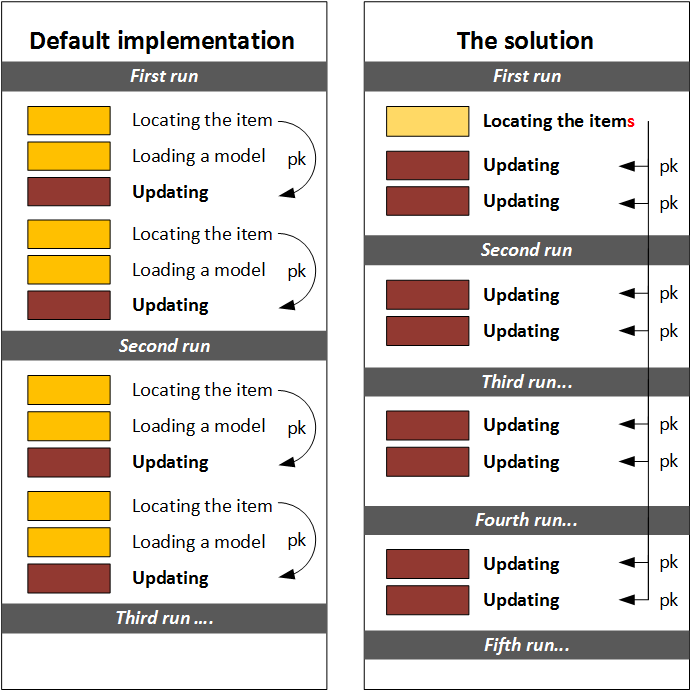
Update on the blog about Hybris. I found a way to speed up data import into hybris by two times.
Briefly, during data import, hybris makes three requests (not to the database, but internal ones, which without cache, turn into three database queries): locate an item by certain criteria, retrieve all information (model) about it, modify the item. The locate/retrieve steps are cached, which provides some acceleration, but it’s better to eliminate them if possible.
In my solution, the first two requests are absent. For instance, when updating prices or stock, it is senseless to look at existing data – it needs to be overwritten with fresh info. Tests show a twofold difference.
The fastest method – writing directly into the database, is highly discouraged by hybris, for many reasons. This method is kosher, as it uses a mechanism officially presented by hybris (although, recently). What is described in the blog is not documented by SAP, and it also has certain flaws and limitations. However, for updates like prices and stock, for example, it is 100% suitable.
September 25 2016, 17:48
September 25 2016, 17:46
Liza had her third competition yesterday, this time in Washington. She ran 5 km in 23:51, i.e., a kilometer in 4:77. Smart girl! Seems like she’s already running better than me;) I’ve edited the video, posting it #dcxc
September 25 2016, 16:54
This is a high school American football competition, Liz’s school is playing against South Lakes. Liz’s school lost with a score of 8:75.
Note that each team brought their own cheerleaders. A few spectators came with the guests, but half of the stands on the home side of the tournament were filled with students in red shirts – these are the colors of McLean High School. Right there in the stands, the school band plays intermittently.


 Hi, I'm Rauf Aliev.