
Have you heard how squirrels swear? It was Yuki who chased her up the tree
Category: facebook
May 14 2023, 21:48
I recommend it, a very good toy for dogs. It’s called the Wobble Wag Giggle Dog Ball. It costs $13 for the size shown in the video, which is considered large, $11 for a smaller version, and $8 for the smallest one. There are no batteries required. The design is ingeniously simple. There are three tubes at different angles. Inside each is a movable squeaker. It squeaks when air passes through it. When there’s room for the squeakers to move within the tube due to gravity or centrifugal force, it moves, allowing air to pass through, creating sound. The pressure isn’t instant due to air resistance, so the sound extends over time. The squeakers in each tube are slightly different, so it produces a cool sound.
We bought the largest ball for Yuki, which supposedly cannot fit in his mouth. But Yuki has figured out how to cleverly grab it. And now he carries it from floor to floor.
May 14 2023, 20:15
A very interesting map. You can open any place in the world and see which languages are spoken in specific spots. Try opening India for instance 😉 In the USA, it’s also quite complicated. Not only with Pennsylvania German above the Amish and Russian at Brighton Beach, but also a plethora of local languages of indigenous tribes and such.
Link in the comments

May 14 2023, 18:01
This is one of the sanitary stops on our bike trail (W&OD). Interestingly, besides toilets and drinking fountains, there is a motorized bike pump and outlets, ten of them.

May 14 2023, 10:43
My 21st attempt at oil painting.
The Desolate Embrace

May 13 2023, 10:39
Here is a typical scene in our parts. If you see a cool car like in photo 1, then the driver and passenger will very likely look like in photo 2. This applies to the third purple Rolls Royce as well. Probably somewhere in Atlanta, a local rapper would be driving the Corvette, and the purple Rolls Royce would have undergone a bit of tuning.
And that’s really great. By retirement, many save up enough money to afford what they missed out on earlier. For some, it’s traveling in Europe; for others, it’s driving around the country in a cool car with their beloved grandmother.


May 12 2023, 10:14
Oleg bravely tackles everything
Everything turns to shit
And if he tackles shit
He just expends less effort

May 11 2023, 19:23
My 20th attempt at oil painting. Nadezhda Shulga for you with love!

May 10 2023, 23:18
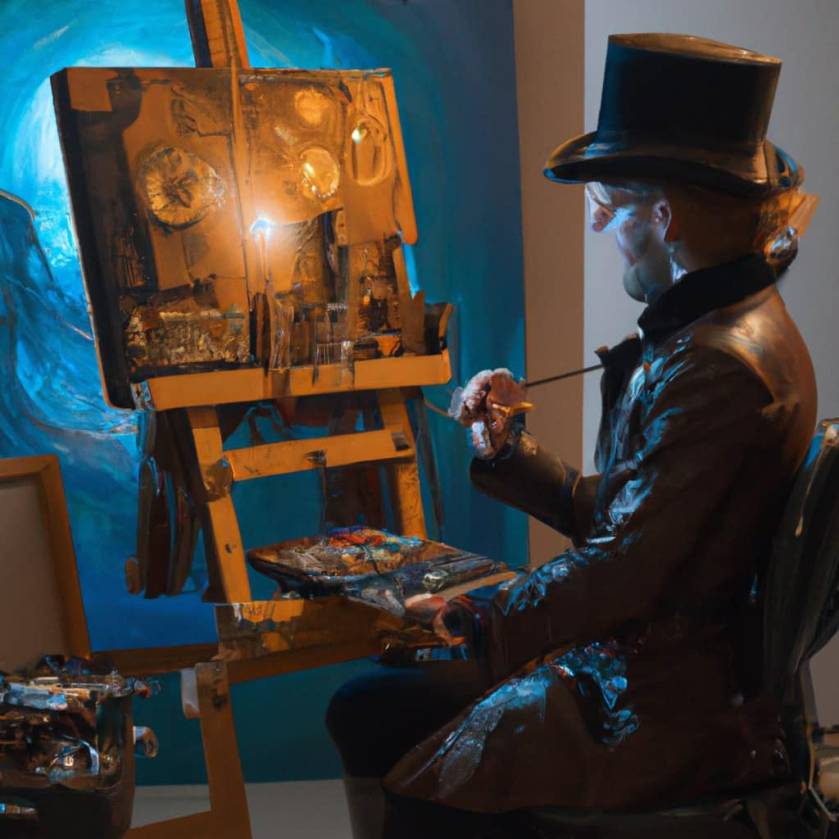
Just published a new article where I explore the intriguing interplay between engineering and artistic pursuits, specifically painting and playing the piano. 🎨🎹 I dive into how these seemingly disparate activities enrich each other, enhancing skills that are crucial in both domains – from fostering an ability to think graphically to honing keen attention to detail.
May 10 2023, 20:13
Sometimes it’s worth trying to rationalize hobbies – although, probably, it’s a strange thing to do. But I have an engineering mindset, so please excuse me.
So, from hobbies, I can clearly identify painting (with oils) and piano. Everything else I do is extremely irregular, without any significant level, and doesn’t really deserve a mention.
If I have to choose between these two, then in terms of effort/result ratio or hours spent/skill level, painting is far ahead. In terms of money spent/skill level, at first glance, piano seems to be ahead (buy the keys once and that’s all), but in reality, ten hours of piano without a paid teacher is equivalent to an hour with a paid teacher, and without any teacher at all, you’ll quickly hit a “ceiling” that will be difficult to overcome, as wrong techniques are already ingrained. However, this ceiling is not exactly low. In painting, a paid teacher can be largely (about 90%) substituted by YouTube if desired. In piano, only about 40% can be substituted. After a year of daily piano practice, you can surprise your friends on Facebook, but a year of daily painting practice can reach a quite good level and even impress professionals. I still have eight months to go until a year, and I paint maybe once a week, so it will take longer in my case. Piano, with the same effort, would take forever. In other words, the piano learning curve is significantly more gradual.
What does painting provide? Why is it needed for an engineer? There are several reasons.
Firstly, the ability to think graphically. At a recent meeting, my colleagues complimented me for drawing a very complex and organically appearing functional system architecture diagram on the fly. I always thought this was a general skill, but it turns out it’s not. For many, it’s a separate type of work that requires focus, and during which one must think about layout and composition.
Second. I don’t know any other activity besides painting, or maybe sculpture, where the brain is loaded with an intense internal dialogue during the process. Programmers will understand me, but this only happens to you and I during rare cases of complex troubleshooting or writing a complicated algorithm in one go. In painting, it can’t be otherwise. Is this spot lighter or not? Are these lines parallel? Do these angles match? Where to shift the red – towards burgundy or pink?
In piano, there is none of that. But there is something else in piano that is absent in painting. In piano, you gradually learn to act ahead of the brain. There, decisions must be made before they turn into words and pass through the brain. Drivers will understand. But this is not about mechanical memory. That’s actually harmful. It’s about, for instance, playing a chord that’s not even sounded in the head yet, but follows the one that just entered the ears. The hands press on something, and then the brain catches up.
Third. Painting provides an interesting skill – paying attention to the distinctive features of familiar objects and forms. You look at a person, and their eyebrows and the lower lines of their cheeks form a neat X. Or a slightly raised bridge of the nose. Or a protruding chin. Or the shadows under the eyes. Or huge ears. For 90% of people, these are unimportant details that they overlook in everyday life. You start noticing that indeed there is a reflection in the shadow part. And that there is no pure white or black. And then it all starts catching your eye. Sometimes this is not a plus 😉
That’s why it’s interesting to learn something new. It opens new doors into how the world around us works. And this is something engineers should know and understand well, so that their work brings more pleasure both to them and to the people for whom they do their work.


