They probably haven’t sold out yet

They probably haven’t sold out yet
Got access to DALL-E 2.
It’s astounding, really.
The first two images were generated from the phrase “mother with daughter holding an open red umbrella on a horse on a rainy night in the style of a painting”. Cool, huh!
Another two images were generated from the phrase “The painting depicts a scene with watches melting slowly on rocks and the branch of a tree, with the ocean as a backdrop”. I simply described a Salvador Dali painting, and DALL-E created its own version.
I also asked DALL-E to draw a picture based on the phrase “an impressionist oil painting of a female figure skater dancing with her male partner, with the mountains and lakes as a backdrop”, as Masha is currently skating in Lake Placid.
It’s rare that computer stuff surprises me, because I generally understand how they work. I kind of understand here too, but just barely, with great difficulty, and the result is much, much better than the wildest expectations.
I think that soon there will be specialists emerging who craft requirements for such devices in the form of text. They will manage to get higher quality images through their formulations


I wonder why all voice-to-text programs do not try to identify the topic and load terms specific to that topic? Here’s a conversation about, say, horses. Load a dictionary with terms, horse brands, typical names, names of racetracks, or whatever else, and run recognition again, using terms from this dictionary with more weight than terms from, say, IT or cooking. Understanding that it’s about horses from the text AI can do for a long time. But adapting, it cannot.
Or consider recognition in Teams. Microsoft, you have gigabytes of messages from chats and groups. It’s quite obvious that roughly the same words will be heard in the audio. Why not compile a dictionary of such words and load it into the voice recognition system to make transcriptions more accurate? I’m not even talking about the fact that the same person writes and speaks generally about the same topic. If we take his messages for the dictionary and apply this to the statements he makes, and secondarily to those who are in the call, it would be just perfect.
One could think about how to improve existing recognitions. Like, over a week accumulate knowledge of how, say, Medik8 sounds and is spelled (from chats), and then change all incorrectly recognized ‘medicate’ to Medik8 in past meetings (including updating the search functionality to reflect the changes). Understanding that it is wrongly recognized is nontrivial for a machine, but still possible, since the word medicate clearly does not fit grammatically, unlike Medik8.
A proper startup needs to emerge that integrates with messengers and meeting apps, doing all this smartly, while charging some money. If all internal meetings were transcribed (properly! with replicas, names, taking into account the topics) and there was a unified search considering access rights (you can only search meetings you are invited to), it would be a supertool.
Recently on my iPhone, Youtube has suddenly started to work in the background. That is, you leave the app and the video continues to play in a window (Picture-in-picture). This used to be a Premium-only feature, and I definitely don’t have it.
Is this the same for you, or did my app glitch in the right direction?
Google knows what to show me as the first link for a scooter lock. Just $8500. Rock solid.


Tempting

A simple formula, which I had never considered, having worked in executive positions at several companies: a director is a manager of managers. If you are a director, but have specialists (individual contributors) below you, then you are not a director but a manager, regardless of what your position is called.
Expanding on the topic, if you are a manager and have no subordinates (those who report to you and whose work you are responsible for), then you are not a manager, but in essence a specialist. In the fields of project management, sales, procurement, or HR.
If only such definitions were simple, everyone would find it convenient. Do you agree?

Just published a new article on Hybrismart.com:
End-to-End Test Automation: Why Was It Worth to Write Our Custom Framework
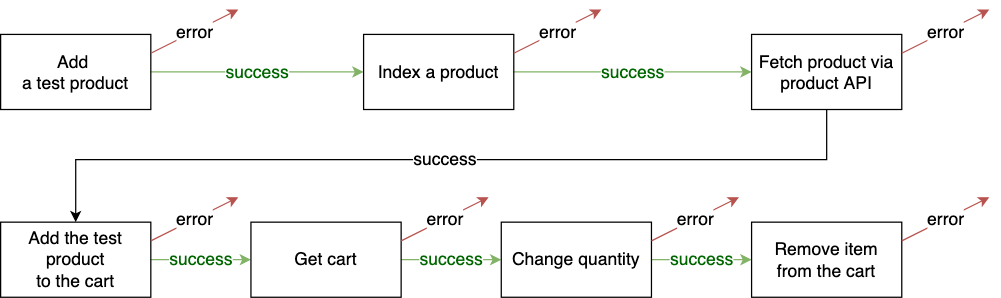
There are dozens, even hundreds of test automation frameworks available, and we developed our own. Why? Why? Was it worth the effort?
This article describes our needs and our solution, E2E CLI: the architecture of the API testing tool which has been used by our team for about 2 years. Back in 2020, it was developed by me from scratch over the course of a weekend — In other words, it is a very simple piece based on very simple ideas.
We use this tool to end-to-end test all our services and integration flows. Whenever we make changes to a software system, we need to ensure that they do not break what was already working.
As the architect and lead developer, I designed and developed it from the ground up, so, of course, I am very proud of my brainchild. But the field cannot be well seen from within the field. You know, reinventing wheels is not always bad. When you build something on your own, you are in full control over what is being built, what its purpose will be, and when it is finally conceived and executed as you wish. It has been two years since I have encountered any alternative to our solution.
To reach a wider audience, I found it beneficial to share key concepts hoping to get some feedback from the community and enhance the product.
First time seeing a toilet monitoring system. You could actually create charts and send alerts to the staff.