
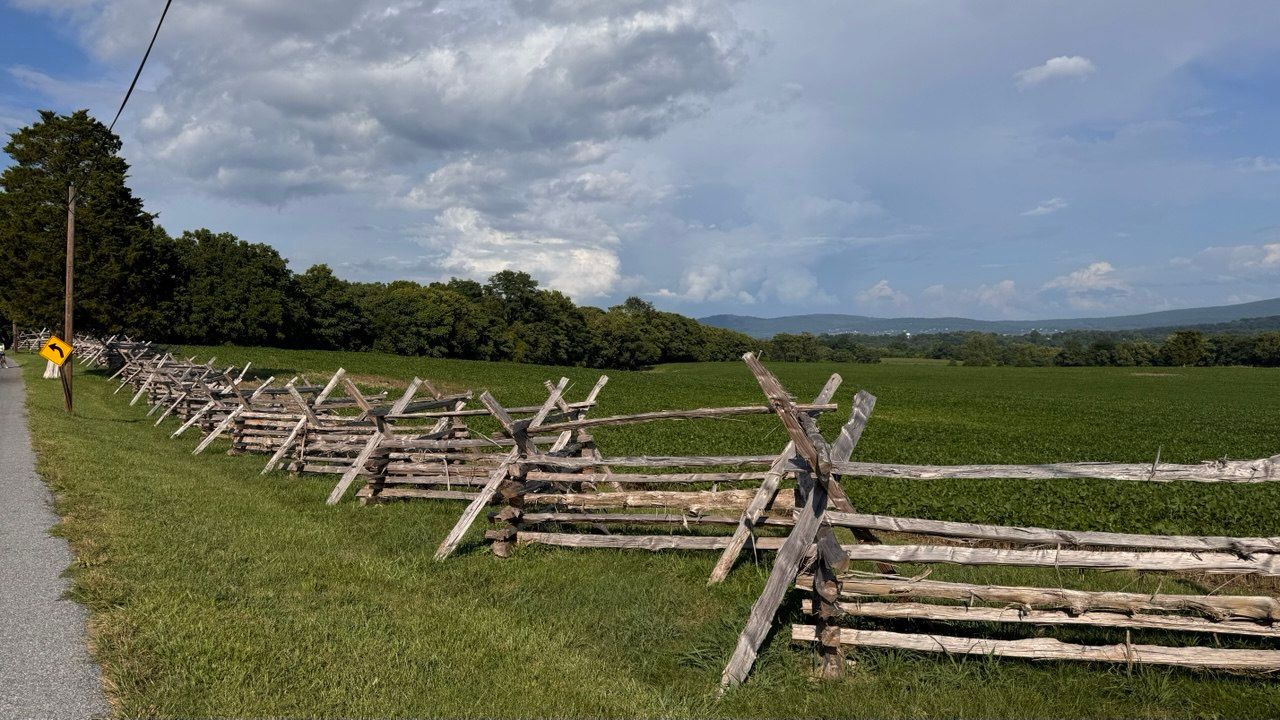
Today we went biking in Sharpsburg, where the Antietam National Battlefield is located. I was drawn to the zigzag-shaped fence, which is called a Buck-and-rail fence in English—a fence made of posts and rails. It was widely used in the US, particularly in rural areas, from colonial times up to the 19th century.
The unique feature of such fences is that they are very quick and easy to build on any terrain—no nails are needed, and the way the parts connect ensures everything holds together naturally very tightly. If a hypothetical cow were to try and push this fence, it would only drive itself deeper into the ground and “strengthen” further.
I found this interesting also because it reminds me of a similar structure made of bricks but wavy this time. It’s particularly common in England, but you can find it in the US too. For instance, the University of Virginia has had such walls for two hundred years.
The most interesting aspect of the wavy wall is that this type of construction uses FEWER bricks than building a straight and even wall of the same strength. When constructing a regular flat wall, bricks are typically laid in at least two layers to ensure its strength, whereas a wavy wall allows for saving on bricks and using just a single layer. Its stability is provided by the alternating convex and concave bends.


 Hi, I'm Rauf Aliev.