
Does anyone actually play this?
P.S. ASMR games typically involve soft sounds (rustling, whispering, tapping), a calm atmosphere, and a relaxing gameplay that helps reduce stress and relax.

Does anyone actually play this?
P.S. ASMR games typically involve soft sounds (rustling, whispering, tapping), a calm atmosphere, and a relaxing gameplay that helps reduce stress and relax.
Cultural page. It was a surprise to see Bryullov’s work, and not just any work, but the famous portrait of Countess Samoilova (with a black boy and a ward), which it seems everyone knows right from school benches, along with the equally famous “Horsewoman”, also depicting her. Bryullov, generally, isn’t that well-known outside of Russia, and there aren’t many of his works in museums. This Samoilova, by the way, even appears in Bryullov’s “The Last Day of Pompeii” three or four times.
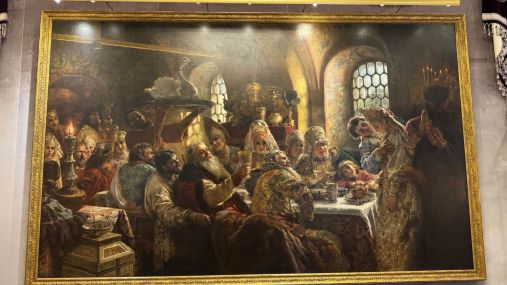
Across from Samoilova, the boyars are drinking. This painting, for some reason, is entirely unsigned. It’s a large, wall-sized canvas by Makovsky, “The Boyar Wedding Feast”. It invites prolonged viewing — every detail is captivating.
In the same hall, a third surprise awaited me — a portrait of a young black man. This was Lloyd Patterson. As it turned out, this gentleman ventured to the USSR in 1932 in search of racial equality, work, and simply a better life. In the Soviet Union, Patterson was invited to work as an artist on the film “Black and White”, the idea of which was to expose racism in America. The project was eventually canceled, but Lloyd stayed in the Soviet Union, mastered Russian, and married a Soviet artist and designer, Vera Aralova. It could be said that the issue of racism helped him settle his life.
Here in the USSR, his son, James Lloydovich, was born, and this young man is the same one who played in the famous film by Grigori Alexandrov “Circus” as the son of Marion Dixon – the American artist portrayed by Lyubov Orlova.
He grew up, became a poet, a prose writer, published in the USSR. Right after the USSR came to an end, James emigrated to the USA, and has been living here, in Washington, for over 30 years now. He is already 91 years old. He recently released a book titled “Chronicle of the Left Hand: An American Black Family’s Story from Slavery to Russia’s Hollywood”.
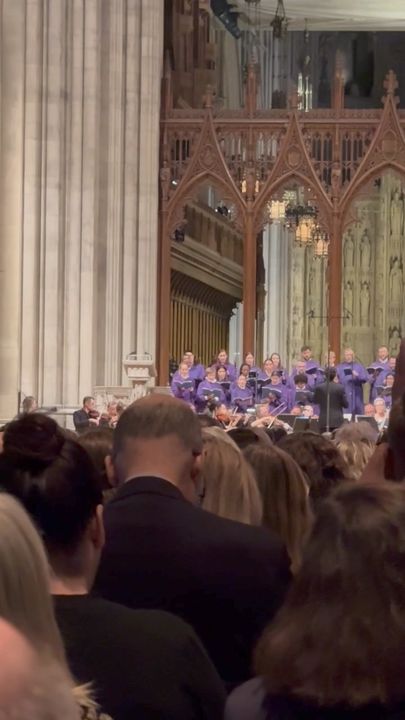
After the museum, we went to Mozart’s Requiem at the National Cathedral. The warm-up for Mozart was the Berlin Mass by Estonian composer Arvo Pärt. Too slow for me. But the Mozart Requiem I’ve heard about a hundred times, and this was my second time hearing it live (the first time was in a church in Moscow). Still, I can’t say I was very satisfied, coming to a live performance in one of the largest cathedrals in the world: I skimped when choosing seats and ended up in the back. I should have bought tickets closer to the front. By the place we were sitting, the sound was turning into a muddled “mush.”



We just fueled up at the church. Those entrances from both sides—that’s the gas station. By the way, gasoline costs $3.3 per gallon. And five minutes ago, we did NOT fuel up at the station outside the city opposite the CIA for $5.1 per gallon.



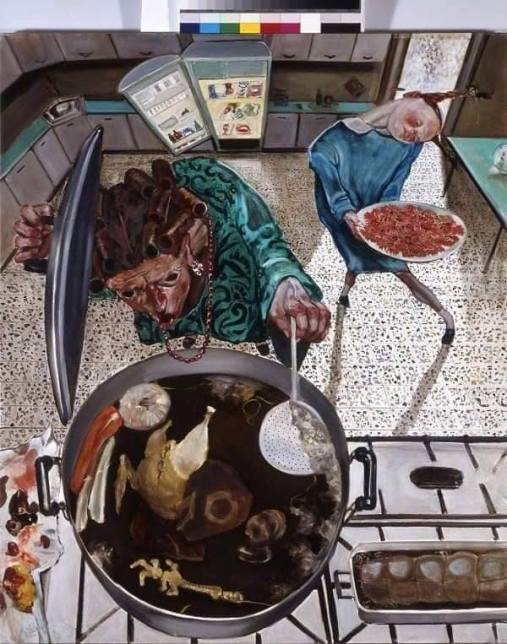
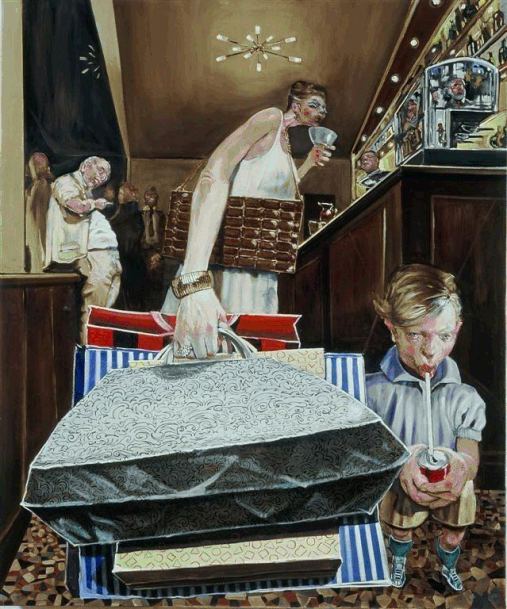
Today, I want to share with you an artist whose works are truly bizarre—Enrico Robusti (born 1956). Imagine putting door peepholes over your eyes instead of glasses, downing some vodka, and then visiting your relatives after banging your head a couple of times on a speeding tram. The result? Probably nothing good, but at some point, you might start seeing something akin to what this artist captures in his paintings.
I’ve always believed that consistency and the development of a unique style are more important for an artist than technique. Even if that style is highly controversial, over time it gains value. Perhaps only among a small circle of enthusiasts, but that circle forms a solid foundation for future popularity, and who knows—you might even leave a lasting mark on art history.
I can’t say I like Enrico Robusti’s work, but I can’t deny that it grabs your attention and stands apart from everything else. Yes, the pieces are somewhat repulsive—some even more than others—but that’s precisely the point, so it works.
Posts like this are grouped under the hashtag #artrauflikes, and all 109 of them are available on beinginamerica.com in the “Art Rauf Likes” section (unlike Facebook, which tends to forget—or ignore—nearly half of them).









Today, the artist who adores capturing the stunning repose of maidens—Serge Marshennikov (1971)—continues to astound. Quite an achievement for a graduate from the Ufa Art School. Some might question the purpose of crafting oil paintings that mimic photographs to a near-perfect degree. On the flip side, however, the artist’s role extends well beyond merely transferring an image onto canvas. From conceptualizing and composing to setting the lighting and evoking the intended emotional response in viewers, every facet is impeccably realized here.
Related posts are found under the tag #artrauflikes, with all 108 entries available in the “Art Rauf Likes” section at beinginamerica.com (unlike Facebook, which overlooks nearly half).










I gather I should already expect that my printer will soon start showing ads, right?

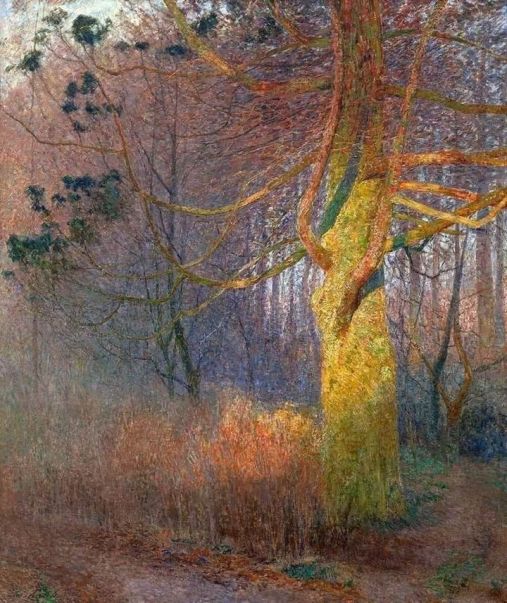
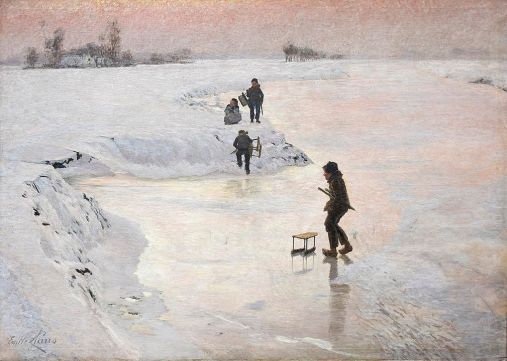
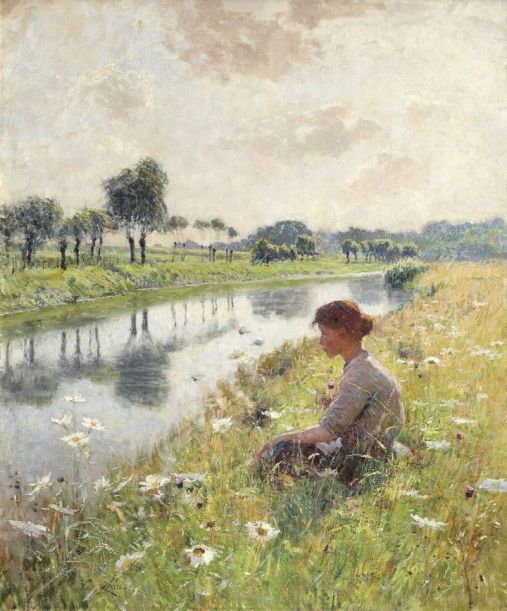
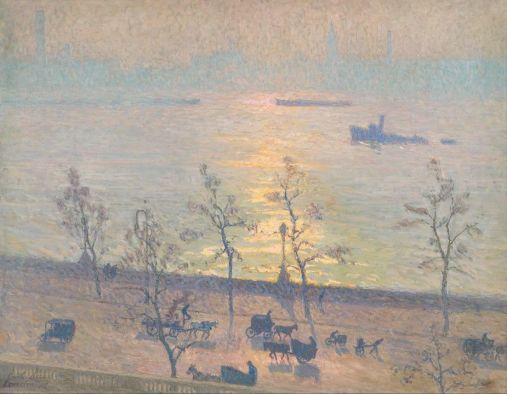
I find myself returning to the “classics” from contemporary artists once again. Today, it’s the paintings of Emile Claus. In just a couple of days, he’ll be celebrating his 175th anniversary.
Impressionism, my favorite art movement, this time in its Belgian form. Claus’s technique gave rise to the artistic movement known as “luminism.” Other artists associated with this style include Joaquín Sorolla, whom I wrote about earlier in May.
Posts like these are grouped under the hashtag #artrauflikes, and you can find all 107 of them in the “Art Rauf Likes” section on beinginamerica.com (unlike Facebook, which tends to overlook nearly half of them).





A very intriguing video about vulnerabilities in mobile communication.
In brief, the gist is this: due to the expansion of the network of cellular operators, control over who enters “the club” has been lost, and it’s fairly easy to gain unauthorized access to the SS7 network, through which mobile connections are managed. From there, one can do anything: intercept calls and SMS, record calls without the caller’s knowledge, and even track locations — in cities, it’s incredibly accurate. Access to the network simply costs money. And, of course, one must know what to do and how—it’s just knowledge, albeit rare.
A notable example is the case with Princess Latifa from Dubai, who was captured after an attack via SS7 allowed the location of her yacht captain’s phone to be pinpointed.
A live attack is demonstrated, in which a hacker intercepted a phone call intended for someone else. This was done by deceiving the network into thinking that the victim’s phone was in roaming, which allowed the hacker to redirect the call.
In the discussion, it is emphasized that, although newer protocols introduced with 5G are more secure, the transition to them is slow due to network effects: all operators need to switch at the same time to fully benefit from the advantages.
Conclusion: SMS is evil. Use authenticator apps or hardware tokens for two-factor authentication. Or, just don’t stick out so much that someone would not mind spending a few thousand dollars to hack specifically you.
Links in the comments.

I wonder if it’s just me unable to find it, or if it doesn’t exist — an app for Mac where you can specify a folder with PDFs, let it work overnight to create a vector index, and then search through them using natural language queries. For creating embeddings and for the RAG reasoning phase, models could be downloaded onto the computer, and in this case, it would work as fast as the computer allows. If you enter an OpenAI key, then OpenAI would be utilized.
It would also be convenient if such a tool could take a URL as input – for example, through a click on a browser extension button, and then allow searches across all documents, including that URL.
It would be great if one could create indexes with a single click. Say you receive a 200-page PDF on biology, you throw it into the “biology” index, or one on mathematics, you throw it into the “mathematics” index.
I know how to build this from scratch. But all solutions require a somewhat advanced understanding. There’s something like automatic1111 for Stable Diffusion; I wish there was something similar for working with an archive.
I wonder why no one has made a player that integrates with the Apple Watch, and turns off the background music (for example) when the pulse shows that the person has fallen asleep? Ideally, if it could do the same with YouTube or any other service. Essentially, it involves opening a browser window with YouTube, then I start whatever I need, and at the right moment, when the watch reports that I have fallen asleep, simply closing that window.
 Hi, I'm Rauf Aliev.