
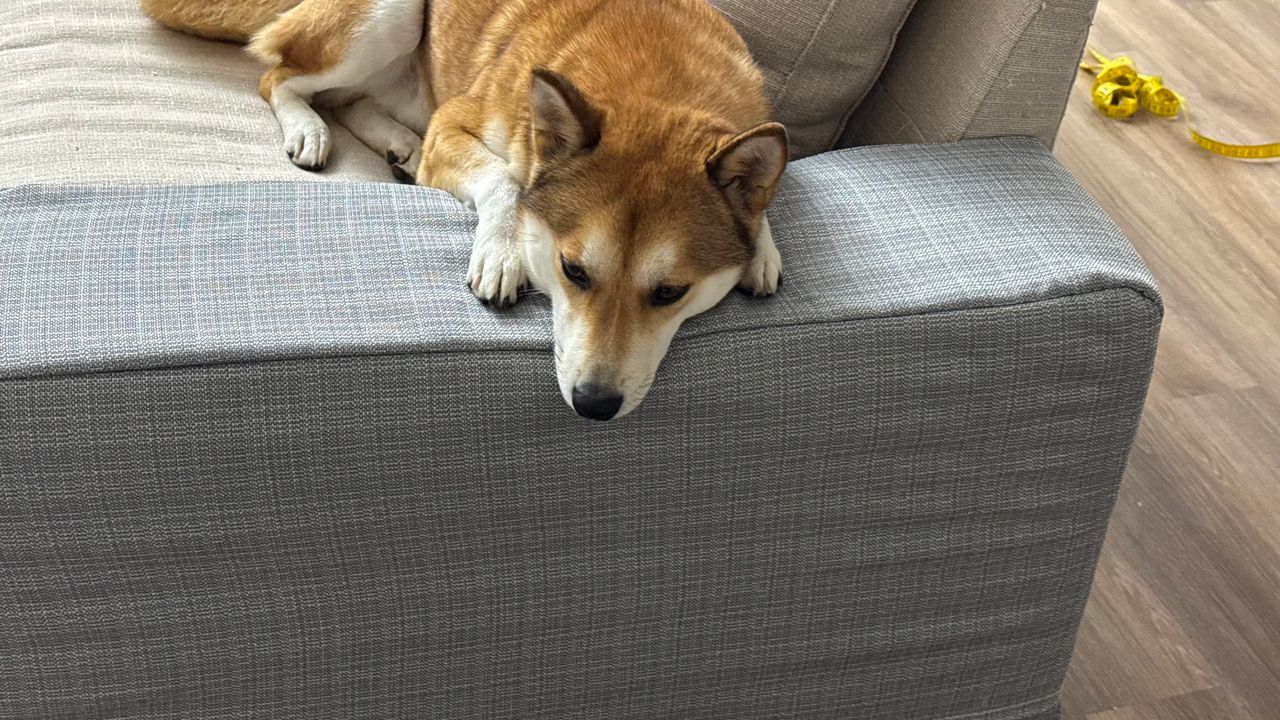
ME AND THE SEWING MACHINE. Yuki owns an Ikea sofa. I occasionally read on it too, but essentially, the sofa is truly his. He’s very meticulous with it (as with everything, really); we wash the covers, but over time, they began to look less presentable, and I decided instead of buying a new set for $99, I’d at least sew some armrest covers. So, it’s going to be two-tone.
Yesterday, I hopped on my scooter and zipped over to Hobby Lobby. Picked up 2 yards of fabric for 20 bucks.
Look, this isn’t my first rodeo, but I hate it every single time. How do seamstresses manage to love this kind of work? It took me 4 hours just to make one armrest cover. I’m definitely not continuing and am now switching back to the original and ordering a set.
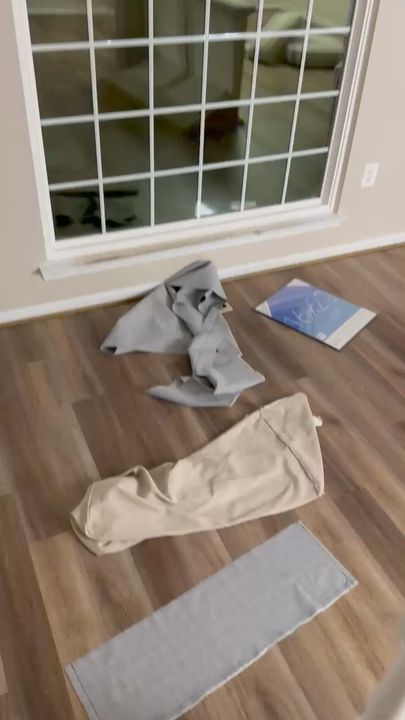
This whole endeavor is an engineering feat, no simpler than programming, I swear. First, you have to reverse-engineer the reference item. That’s a major challenge, especially if you don’t want to cut up the item. In this case, it’s just a cover, which is simpler than, say, shorts. So, it became clear that I needed three pieces of fabric, 45×88 cm, 178×23 cm, and 30×88 cm, plus each piece must have at least 2 cm allowance on each side.
The first challenge is just drafting all of this on the fabric in order to cut it later. Especially if the fabric has a pattern. Overall, millimeter precision isn’t necessary, but what’s needed is a) straightness of the lines b) the same angle with the fabric fibers throughout the straight lines, ideally at a strict 0 or 90 degrees. This is all quite complicated to achieve, especially if you need to cut a piece 188 cm long. You spread it out on the floor, and if any section of the fabric shifts by a couple of millimeters, then there you have it, the line will be crooked. So ideally, you need to secure/stretch the fabric and then draw along it.
Then there’s the separate issue with the fabric itself. First, if you follow the fibers with your eyes, you realize the fabric, or the pattern, does indeed break up periodically, or zigzags, and you can’t see past ten centimeters. Second, the fabric might stretch. Besides that, when you try to smooth something out, it slightly increases or decreases in different places, so that straight lines aren’t straight anymore. After washing, everything will probably return, but it’s bothersome nonetheless.
Separately, what you draw with. Whatever draws on the fabric needs to be erasable afterward and thin enough so that the blade doesn’t wander. A marker might not work. Okay, if you’re drawing on the inner part, it might be okay, but it won’t work with transparent and semi-transparent fabrics.
Next, what to cut with. Scissors obviously don’t work, unless you use them as a knife, not as scissors. There is a special knife. Pretty convenient, I must say.
So, we cut it. That’s half the job, but it takes a lot of time. The rest is technically simple – sewing these pieces together. But that’s if it’s just simple sewing. Any cheapest Chinese product is five times more complex than this “simple sewing.” At least, you need an overlocker (I have one). Plus, you need perfectly straight seams, and for that, you need more skill, as at slow speeds they don’t come out right (my skill is so-so, but if not rushed, generally what’s needed is achieved).
In general, the hassle with this is such that it’s easier to give up. Ultimately, I’ll be ordering a new set. If I ever think of sitting down at the sewing machine again, please remind me that there are far more interesting things in the world, and I definitely underestimated something.
But on the plus side – I can now say that, overall, superficially, I understand how it all works. Now I’d be interested in seeing how this is automated. How they manage to produce shirts for a dollar — it’s definitely not just because the Vietnamese in the factory are working for food. Surely there’s a lot of automation involved, where problems mentioned above were solved ages ago.

 Hi, I'm Rauf Aliev.