
In just two days, I devoured Nabokov’s “The Defense of Luzhin.” A masterpiece! Next, I’ll be reading Lolita in English. While reading “The Defense,” I took notes. To avoid losing them, I’ll publish them here. My comments are in square brackets. Well, where they’re needed. Feel free to share, this is definitely interesting 🙂
…listening to the voice of his wife, coaxing silence to drink cocoa…
…and she had a turn of the head that hinted at possible harmony, promising true beauty, unfulfilled at the last moment…
…don’t mess up this table…
…a fire was burning, a fat man in white was shouting something, and a tower of plates ran on human legs…
…having sopped up the buldegomes, he asked if he could leave… [chatgpt told me that buldegomes are a hybrid of bullterrier and mastiffs 🙂 most likely, it’s boule de gomme – just gum]
…cut along the edge with round teeth, like petit-beurre biscuits… [petit-beurre – is a common cookie made by LU (Lefèvre-Utile)]
…music played, the small room was filled with light, blushing with a watermelon wound…
…he began to appear more frequently at literary evenings, organized by lawyers and ladies…
…a manufacturer, suffering from chronic constipation, about which he gladly spoke, a man with a single thought…
…mothballs emitted a sad, coarse smell. A doomed jacket hung in the hallway…
…A crystal ashtray settled between them, and, dipping their cigarettes into it simultaneously, their tips collided. “J’adoube,” Luzhin said amiably, straightening his bent cigarette… [j’adoube is French for “I adjust, a ritual phrase in chess, uttered to avoid a rule “if you touch a piece, you must move it. Literally, the verb adouber means “to dub [a knight]”)]
…the maid accepted Luzhin’s collapsible top hat. With a subtle smile, Luzhin demonstrated how it snaps shut… [this is a type of cylindrical hat, “chapeau-claque”. Note here ‘claque’ from claquer – to snap. Apparently, it’s not just any cylinder, but a collapsible cylinder. Google Opera hat, it’s the same thing]
…Luzhin in a dishabille, exuding simian passion, and her stubborn, cold, cold daughter… [apparently, dishabille isn’t just a state, but light, simple, home clothing worn after getting out of bed, not donned in front of guests]
…to the left of the corridor was a bathroom, beyond it, a maid’s room… [maid’s room — is a room for the servants]
…”such future is unknown, but sometimes it acquires a special opacity, as if another force joins the natural secrecy of fate, spreading this resilient mist from which thought bounces off…”
…a print hung on the wall… [wall-space — is a part of a wall between windows, door openings]
…the mercury, influenced by the environment, fell lower and lower… [useful if you suddenly feel like discussing the weather]
…he drew his mother-in-law, and she was offended; drew his wife in profile, and she said that if she looked like that, he should not have married her; but her father’s high starched collar turned out very well… [I’m drawing my wife and daughter right now]
…Having abandoned the typewriter, geography, drawing, now knowing that all this was part of a combination, an intricate repetition of moves recorded in childhood…
…the rooms dimmed as if the parts of a telescope had slid together, and Luzhin found himself in a bright corridor… In all three rooms, unfolded like a telescope, it was very bright.. [not very clear what this telescope is about. Most likely, Luzhin perceives the rooms as if they open and close one after another, similar to how sections of a spotting scope or telescope unfold. In one position, he sees one set of rooms, in another, they “shift,” disappear, and he finds himself in a new place.]
…on him was a shaky sector of silken gloss, like a moonlit boundary on the sea… [Gralitsa – turns out, it’s the reflection on the sea of sunlight or moonlight “by a column”]
…the panel slid, rose at a right angle, and swung back.. three people remained on the panel… [the German ‘Panel’ means sidewalk, referring to an event in Berlin. Separately, this and five pages back and forth beautiful descriptions of the brain’s suffering after a bar]
…”I knew one Luzhin,” said the gentleman slowly, squinting (because human memory is short-sighted)…
…from a store of talking and playing devices came chilly music, and someone closed the door so the music wouldn’t catch a cold…
…his fiancee brought him various casual light-hearted books — works by Gallic novelists…
…“But not in one day. There is another establishment. There we will hang on the wall for two weeks, and during this time, your wife will come from Palermo, look at the names, and say: it can’t be, Luzhin is mine … [Interesting. It seems that registries used to give two weeks to check feelings, like now a month is given for divorce]
…During those two weeks, while their names were displayed for all to see, – on the groom’s address, the bride’s address, proposals from various vigilant firms began arriving: coaches for weddings and funerals (with an image of a coach drawn by a pair of galloping horses), tuxedos for hire, top hats, furniture, wine, rental halls, pharmacy items. Luzhin diligently examined the illustrated price lists and stored them, amazed why the bride was so disdainful towards all these curious offers. There were offers of another kind. … [how similar this is to what happens today, if someone dies…]
…the clerk changed his jacket for a worn coat and pronounced the marriage sentence…
…And he remembered how … the word “fascha sounded in the tired priest’s mouth [I couldn’t figure out what this fascha was]
…she also fell silent, and started rummaging in her bag, painfully searching for a topic of conversation and finding only a broken comb…
…a manner, borrowed from a diplomat who spoke very gracefully “skoúl” [refers to the Scandinavian drinking toast skål – “cheers!”. Without googling, it’s impossible to know]
…“The window was empty, but a minute later, the darkness behind the front door parted, and a lit staircase appeared through the glass, marble up to the first landing, and before this newly born staircase could fully petrify, quick female steps appeared on it… Meanwhile, the staircase continued to give birth to people…
…and to say, she reasoned, our troubled times throw us off our game, and it’s understandable that from time to time, one turns to the green comforter… [green comforter — is likely green wine, that is, alcohol spiced with herbs, hops, St. John’s wort]
…you’ll be with him in a yellow house (…) in a yellow or blue. [yellow house — asylum, they were painted yellow. ]
…ageing actor, with a face, groped by many roles…
…at the top, the square night blackened with a mirrored sheen…
.. to hand over the seal coat.. [not from cats, precisely, from seals, but not those. It’s from sea lions]
…a gentle optical illusion occurred: he returned to life not from the side he had left, and the task of distributing his memories was taken over by that amazing happiness which first met him…
…well then, goodbye, – as they say in Soviet… [“Goodbye! as an independent farewell sign appears around the time of World War I and does not immediately become customary. Even the Soviet Explanatory Dictionary of Ushakov, published in the latter half of the 1930s, marks this meaning as “familiar. Let alone the émigrés: for them, the standalone “goodbye was a clear and very unpleasant Sovietism. – Dmitry Sichinava]
…I’ll give him a wafer, – she said. – That’s that.” The wafer didn’t work… [Wafer — this item was used in church rituals, for letters and in medicine. In ancient times, it referred to small ritual breads, with which Catholics and Protestants communed. Wafers also named thin shells made of starch dough or gelatin, in which a medicinal compound was placed, and medicines in this form. Postal wafers were circles of adhesive mass or glued paper. They sealed envelopes and stamped documents.]
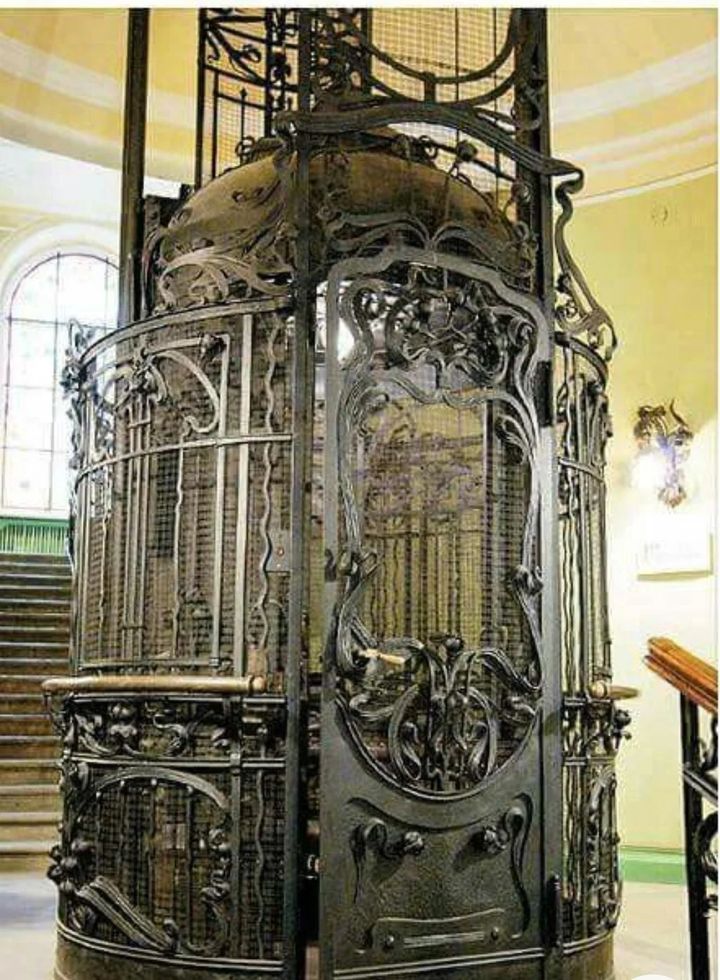
…he recalled how, in a Petersburg house, her asthmatic bulk preferred the elevator, old-fashioned, water-driven, which the concierge operated with a lever on the wall of the vestibule.. [interesting about water- and steam-powered elevators in Petersburg. I didn’t know about that. Attaching a picture]
…a puppet engineer, too large for the locomotive and therefore placed in the tender [tender — is a special wagon that is attached to a locomotive and designed to store fuel (coal or wood) and water, necessary for the locomotive’s operation]
…from the little Luzhin during that first school winter, tenderly smelled of garlic from arsenic injections, prescribed by the doctor. [interesting that even children were prescribed. This was probably “Duplex” — a solution of strychnine with arsenic for injections. A very popular remedy in the past, especially for asthenias, neuroses, impotence, and “anemia”]
…spots of light, scattered along the paths of the garden at the estate, merged into one warm, whole glow [estate — a manor house in the Baltic states, Latvian muiža, for example]


 Hi, I'm Rauf Aliev.