Exploring the Boundaries of AI in Dreyfus’s Pioneering Work | January 10 2025, 01:40

Currently skimming through a book, Dreyfus (1972) – What Computers Can’t Do – The Limits of Artificial Intelligence. In it, across 300 pages, the author convincingly, with numerous references to scientific papers, argues that, for example, programming a chess game is impossible, and intuitive and situational human tasks, such as understanding natural language, are even more profoundly unprogrammable.

The conclusion of the book is that instead of striving for complete autonomy, AI researchers should focus on enhancing human intelligence and exploring the fundamental differences between human and machine minds. They should probably read this book first.

And 53 years later, I am using AI to translate and extract key ideas from this book.

Hubert Dreyfus passed away 7 years ago. Overall, he probably began to suspect long ago that things were not as he had written in the book, because in 1992 he wrote a second series “What Computers Still Can’t Do”.

But the funniest thing is that the 1972 book was printed in Russian in 2010 and can be purchased; it is still widely sold on “Ozone” for 976 rubles. Labeled as NEW!

Adam Clague: Impressionist Painter and His Love for Mandarins | January 10 2025, 00:56

Adam Clague is an American impressionist painter with a particular fondness for mandarins at Christmastime! His wife, Andrea, is also an artist and definitely deserves a dedicated post someday. The light in his paintings is stunning, and his studies are truly fascinating. I’ve selected a few pieces that caught my eye.

Similar posts are grouped under the hashtag #artrauflikes, and all 139 can be found in the “Art Rauf Likes” section on beinginamerica.com (unlike Facebook, which tends to forget—or overlook—nearly half).

Navigating Nabokov’s Narratives: A Journey Through “Lolita” and Beyond | January 09 2025, 00:51

I finished reading Nabokov’s “Lolita.” Started it in the original English, sporadically switched to the Russian translation, and fully switched to it in the second part.

In brief: it’s Lynch’s “Mulholland Drive” in prose due to the convoluted plot and “Leon” for its straightforwardness.

Indeed, the novel’s title features what is essentially a secondary character. The novel is not really about Dolores Haze. Essentially, it’s Humbert’s confession, as Humbert himself titled this book within a book.

I must admit, it feels like I missed half of the subtext, surely so obvious to more sophisticated readers.

Did Quilty exist? Was there an Annabel Lee? And overall, can Humbert be trusted? Is there anyone good in the novel at all?

“Lolita,” like the “The Defense” I read before it, is largely about form, not plot. It’s about “how,” not “what.” Why does Nabokov remind me of Lynch here? Because both seem to overestimate their audience – reader and viewer, respectively. They believe that the intricacies and minutiae cannot only be noticed but also not fail to be seen how beautifully they come together into a pattern and change, like a prism, a generally simple plot.

I was “re-reading” “The Defense” while listening to the audiobook on a drive from New Orleans. 12 hours. For instance, I noticed a reference to the very ending of the book (which you simply don’t know at first reading) at the very beginning, and then essentially a foreshadowing of what the plot would end up like — a book in a book, which is part of the plot (trying to avoid spoilers here). As the author himself wrote: “A book should not be read — it can only be re-read. A good reader, a choice reader, an active and creative reader, is a re-reader.”

Well, now “Pnin” is next in line. Wish me luck — its complexity promises an even bigger challenge. And after that, I might dare to take on “The Gift” — I foresee drowning there altogether.

Exploring the Dual Talents of Jie Gao in Game Design and Portraiture | January 08 2025, 15:43

Meet Jie Gao, a Chinese-American artist primarily engaged in game design, though he also has remarkable works in oil painting (which is why he’s on my radar), particularly in portraiture. As a beginner, I find his paintings fascinating to study—they’re very “informative” in terms of technique.

Posts like this are grouped under the hashtag #artrauflikes, and all 138 can be found in the “Art Rauf Likes” section on beinginamerica.com (unlike Facebook, which tends to neglect—or outright ignore—nearly half of them).

Celebrity Wisdom: Perception vs. Reality | January 08 2025, 03:57

I’ve always been curious: why do people assume that famous singers, musicians, and even artists must be intelligent? For instance, if some lady with a mere three years of schooling blathers some nonsense on the tram, nobody rushes to tweet about it, right? But if it’s not a lady from the tram, but a lady from the TV, suddenly there’s this expectation for her to be sensible.

I also don’t understand why sometimes these same singers are asked to comment on events. And others, probably their fans, for some reason regard their opinions as more substantial than those of an unknown person who is, obviously, closer to the topic.

There are good examples, though—like Makarevich, whose interviews on arbitrary topics genuinely reflect an understanding of how the world works and, I can’t quite find the word, wisdom, perhaps. But if you look deeper—he is just another intelligent person. There are many like him, but he also sings. And if an interviewer wants to talk to him, it’s only because Makarevich has something to say. Most celebrities, in general, have nothing to say. And often, even if a thought does mature in their head, they can’t express it clearly.

If you think about it, people who from an early age dedicated themselves to a profession—athletes, actors, often musicians—inevitably see the world around them skewed by their passion. Frankly, much of it remains unseen to them.

The same goes for Polunin, who can’t write in Russian without a dictionary, yet for some reason, people are interested in his opinion on matters other than the very thing he’s been doing since childhood.

Snowfall and Monsters: Unveiling the Apocalypse Hellfire 6×6 | January 06 2025, 14:19

We had snowfall, and monsters began to appear on the roads.

This is the Apocalypse Hellfire 6×6, a product of Apocalypse Manufacturing. It’s based on a Jeep Gladiator with an 800 horsepower engine. Overall, Apocalypse has quite a lot of different designs, and they are all superb from a design standpoint.

In terms of brutality and design, the renders on the website look somewhat better than this particular instance. Perhaps the workshop invests more into aesthetics each year, and on the road, we encountered something from “past collections.”

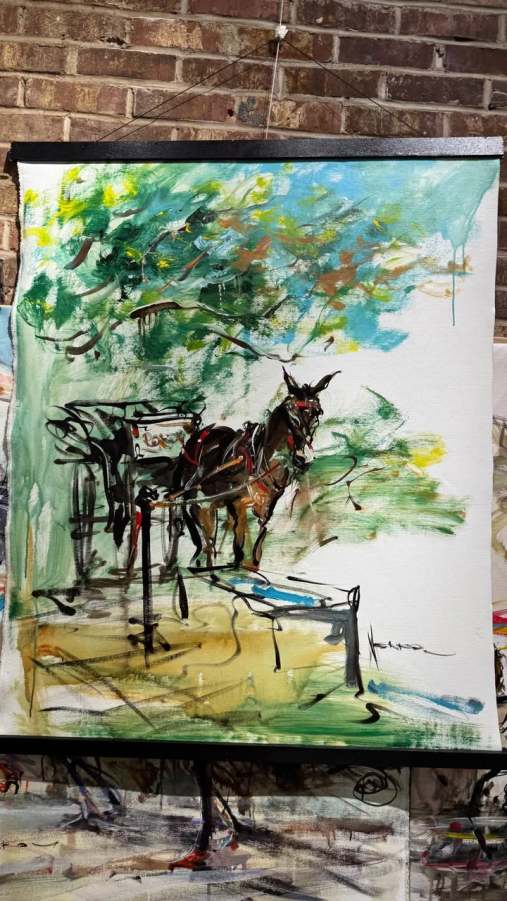
Victor Nenko: A Russian Artist’s Journey in New Orleans | January 04 2025, 17:36

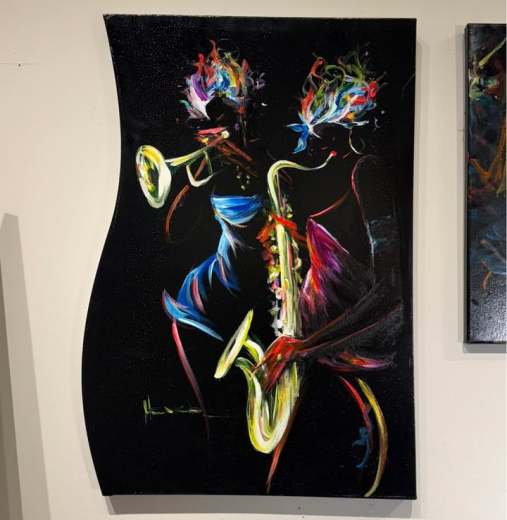
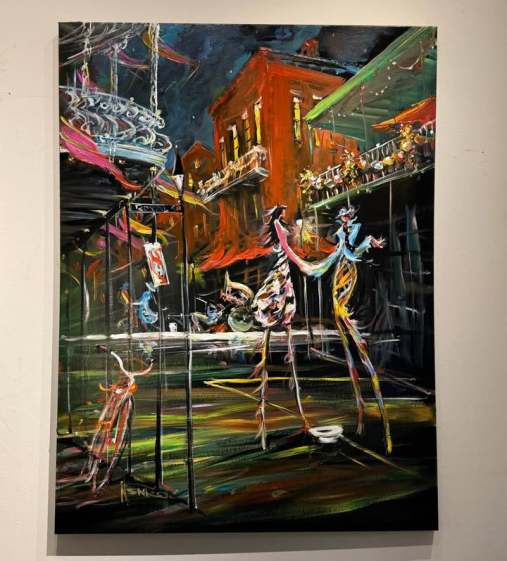
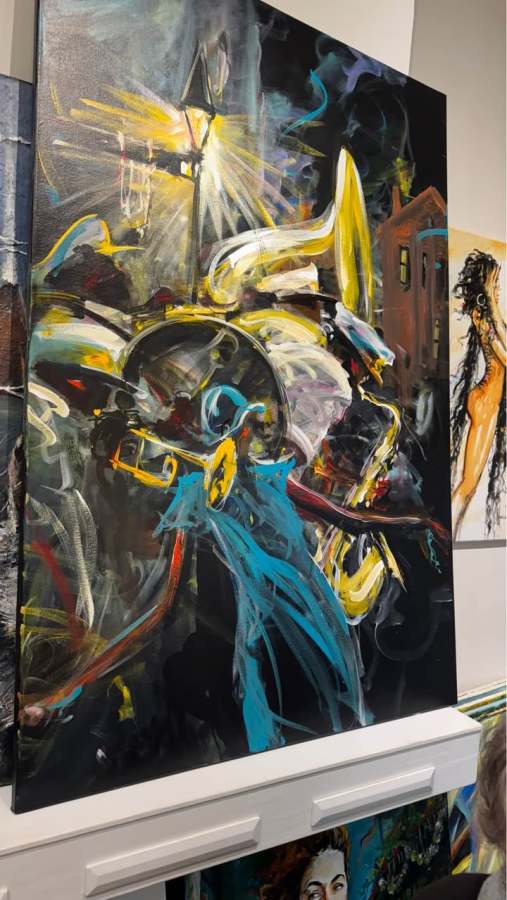
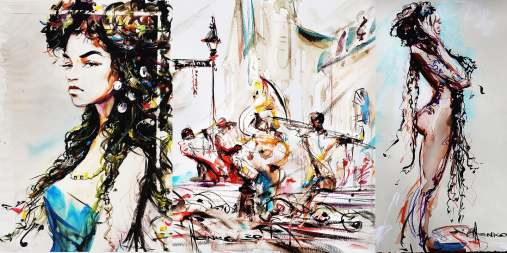
Strolling along Royal Street in New Orleans, we passed a variety of galleries. At one point, Nadia pointed to a painting and said, “Can you paint me something like that? I liked it too, so we stepped inside, and—what a surprise!—the artist spoke Russian. Meet Victor Nenko.

Victor’s works are strikingly expressive, quick, and vivid, mostly done in acrylic. “I gave up on oil paints—they’re harmful, breathing in all those chemicals! Acrylic is a different story, he said. Originally from Siberia, Victor moved to the U.S. nearly 30 years ago. He started out painting portraits of passersby on the street, and now he owns a gallery in the French Quarter of New Orleans.

“I have a degree in architecture, but for years, people kept telling me, ‘Why stick with architecture when you’re clearly drawn to painting? Just paint!’ But back in those days in Russia, it was almost impossible to make a living from art. So I moved to the U.S.

We felt his style perfectly suited New Orleans, especially the French Quarter. While we were in his studio, several people bought prints. “Prints—that’s what pays the bills. Paintings sell less often, he remarked. On Royal Street, it’s hard to find two galleries alike, just as it’s rare to see two identical houses in the French Quarter.

There’s little information about Victor Nenko (Puzanenko) online beyond his artwork and official social media. But perhaps that’s how it should be—an artist’s work speaks for itself.

We left with warm and pleasant impressions.

Posts like this are grouped under the hashtag #artrauflikes, and all 137 of them can be found on the “Art Rauf Likes” section of beinginamerica.com—unlike Facebook, which tends to overlook (or neglect) nearly half of them.