Political Divides in Springfield: Trump vs. Kamala Voting Trends | November 06 2024, 14:56

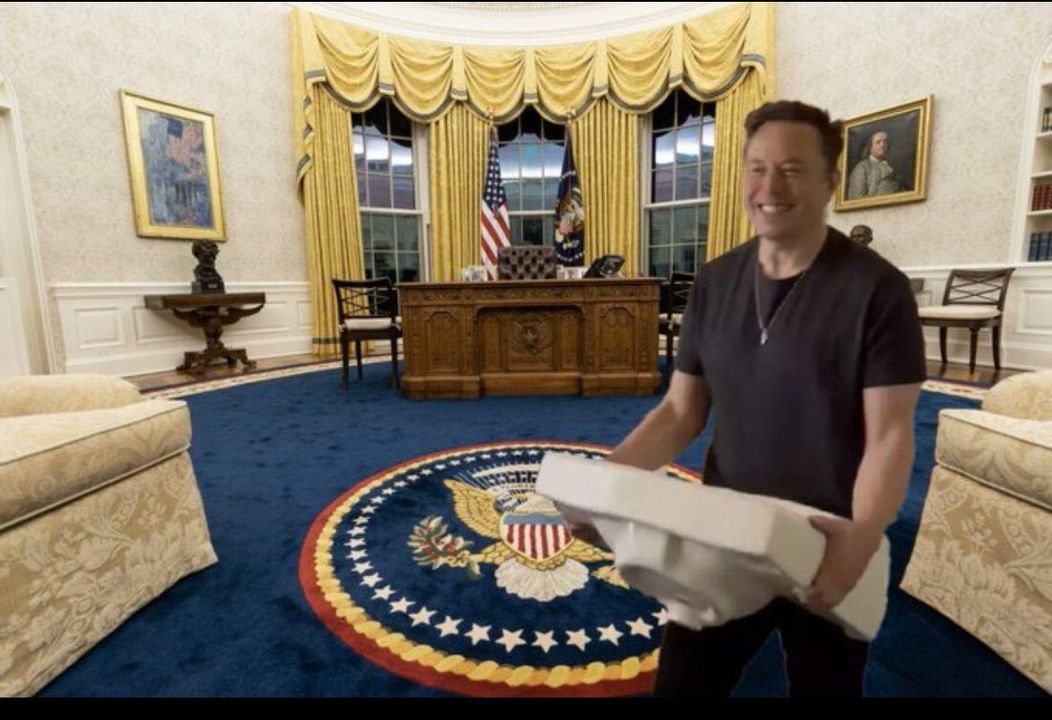
The funniest thing is that in Springfield itself, 64.06% of voters cast their vote for Trump, and almost every district did the same, except for two where nearly 70-80% voted for Kamala. Probably the resentment was just in those two 😉

https://youtu.be/3BrCvZmSnKA?si=8I1JCPzu1rpigS1A

Exploring Dmitry Annenkov’s Hyperrealism: Art or Automation? | November 05 2024, 16:33

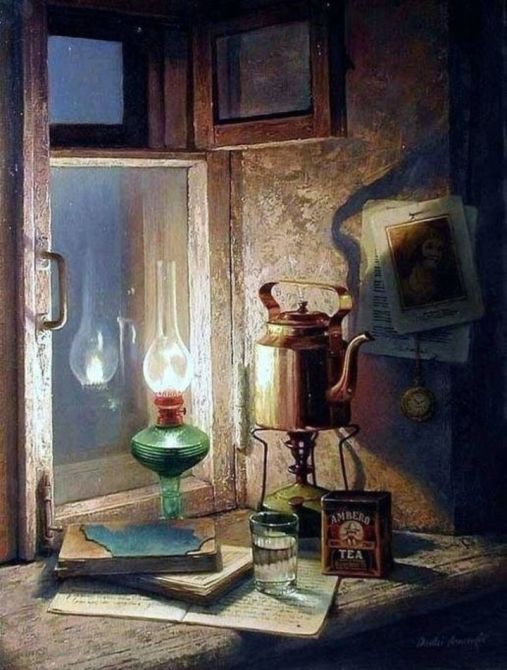
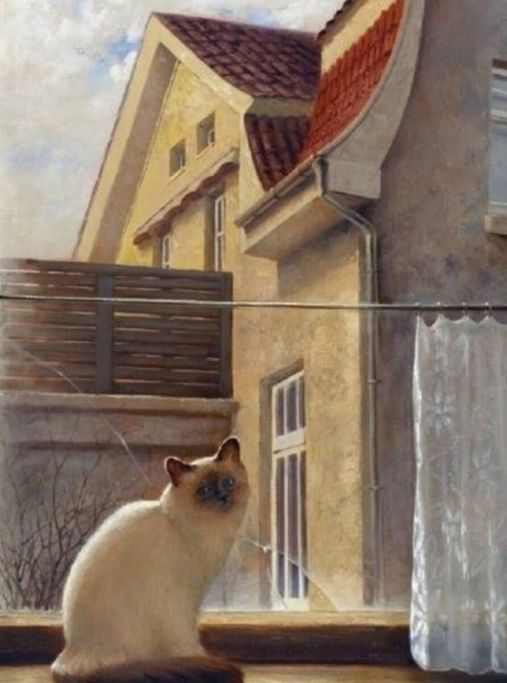
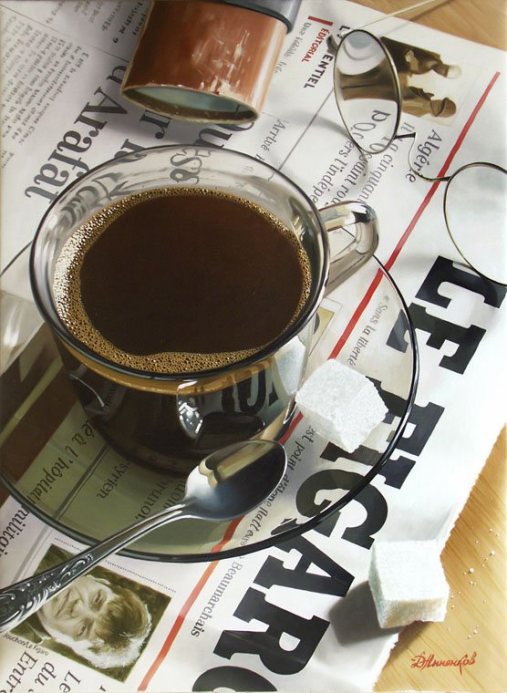
Today’s spotlight is on the works of Russian hyperrealist Dmitry Annenkov. How one can fit so many minute details onto a 40×60 cm canvas is beyond me, but if the Dutch painters managed it back then, why not now? That’s one way of looking at it.

To be honest, I’m not much of a fan of hyperrealism, because I’m left wondering: what’s the point, when we already have photography? Hyperrealism might give the impression that, if you select the precise color from a photograph using a colorimeter and apply it exactly to each millimeter of the canvas, with enough time, patience, and perhaps a bit of automation (like a canvas printer?), you’d end up with something close to what Annenkov creates. With more automation, you could churn out a painting a week. That’s why I find it far more intriguing when the mind has to fill in the gaps itself. Here, there’s nothing missing; the brain just ends up bored. Even watching the process would be interesting. Take, for example, those apples in water—was it painted layer by layer, moving from general forms to details, or simply from the top-left corner down and to the right, like a printer? If there were any visible signs of layering from broad strokes to fine detail, it would be a different conversation entirely. But I don’t see them anywhere.

I haven’t seen a single high-resolution image where you can make out brushstrokes, nor any YouTube videos showing the process—or even an interview.

So, forgive me, but I can’t help thinking critically and suspecting that these works might just be printed on canvas from photographs in oil paint. I’m really looking for arguments against this heretical, and probably offensive, idea for the artist. Do you have any?

But even if it is done with a printer, it’s still art. After all, you have to set the scene, arrange the lighting, take the photograph, and transfer it to the canvas. All of that takes a great deal of effort and time, and the result is something that admirers of beauty are willing to pay for.

Posts like these are grouped under #artrauflikes, and all 127 of them can be found in the “Art Rauf Likes” section on beinginamerica.com (unlike on Facebook, which seems to forget—or ignore—almost half of them).

The Fabrication of Poet James Clifford | November 04 2024, 15:33

This is an excerpt from the poem “Square” by English poet James Clifford, translated by Vladimir Livshits. Clifford was a man with a remarkable destiny, crushed in the vices of two world wars. He was born on the eve of World War I, in 1913 in London, and died in 1944 while repelling a German tank attack in the Ardennes.

Paradoxically, the legacy of the young English poet was better known in the Soviet Union than in his homeland. While in England they asked, “Who is Mr. Clifford?”—in the USSR, his new poems were regularly published from the mid-sixties onward. Thanks must be given to his translator—Vladimir Livshits. He was the first to translate into Russian the famous, seemingly familiar lines from “Retreat in the Ardennes”: “There were five of us left. In a chilly dugout. The command had lost its mind. And was already fleeing.”

But Livshits didn’t just translate these lines; he practically “sanctified” them, because James Clifford, the young English poet who fell in 1944 while repelling the German attack, was for Livshits not just a translation subject but also his own creation. The real James Clifford, who supposedly was born in London, lost his parents early, and was raised by a grandfather—a connoisseur of English and Scottish folklore—never actually existed. Following Walter, Livshits repeated: “If Clifford did not exist, it would be necessary to invent him.” And he invented him.

For decades, Livshits published his own poems in the Soviet Union, presenting them as translations of the non-existent English poet James Clifford.

(taken from the video “Armen and Fedor,” “Comrade Hemingway: How the USSR reforged the novel ‘For Whom the Bell Tolls’?”)

This is how you hack the system 🙂

* * *

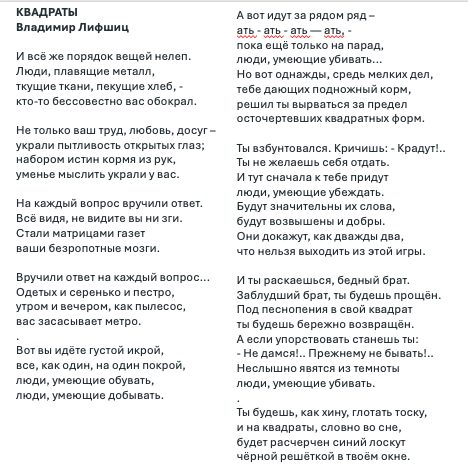
SQUARES

Vladimir Lifshits

.

And yet the order of things is absurd.

People, melting metal,

weaving fabric, baking bread—

Someone has shamelessly robbed you.

.

Not just your labor, love, leisure—

They stole the curiosity of open eyes;

Feeding truths by handfuls,

They robbed you of the ability to think.

.

For every question, they handed an answer.

Seeing all, you see nothing at all.

Your unquestioning minds

Have become matrices of newspapers.

.

They have handed an answer for every question…

Dressed both drab and colorful,

Morning and evening, like a vacuum cleaner,

The metro swallows you up.

.

Here you go, dense as caviar,

All cut from the same cloth,

People who can shoe,

People who can procure.

.

And here they go, row upon row—

March – march – march — march,

So far only for parades,

People who can kill…

.

But one day, amidst the trivial affairs,

Feeding you crumbs,

You decided to break out

From the tiresome square forms.

.

You rebelled. You scream: “They steal!”—

You refuse to comply.

And first, those will come to you

Who know how to persuade.

.

Their words will carry weight,

They will be exalted and kind.

They will prove, as twice two,

That you cannot leave this game.

.

And you will repent, poor brother.

Misguided brother, you will be forgiven.

To chants, you’ll be gently returned

Back to your square.

.

And if you persist:

– I won’t give in!.. No going back!…

Silently, from the shadows

Will come those who know how to kill.

.

You will gulp your despair like henna,

And on squares, as if in a dream,

A blue patch will be lined

With a black grid in your window.
The Destructive Genius of Yuri Pimenov: A Forgotten Moscow Artist | November 04 2024, 01:29

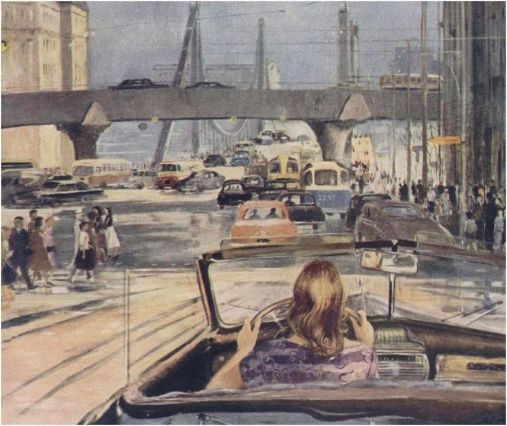
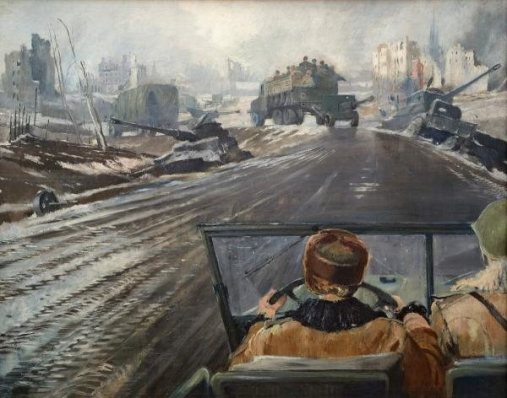
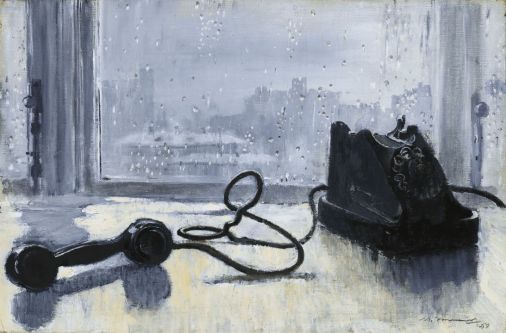
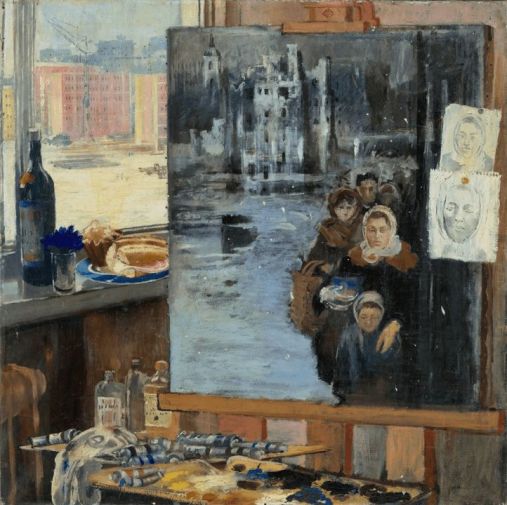
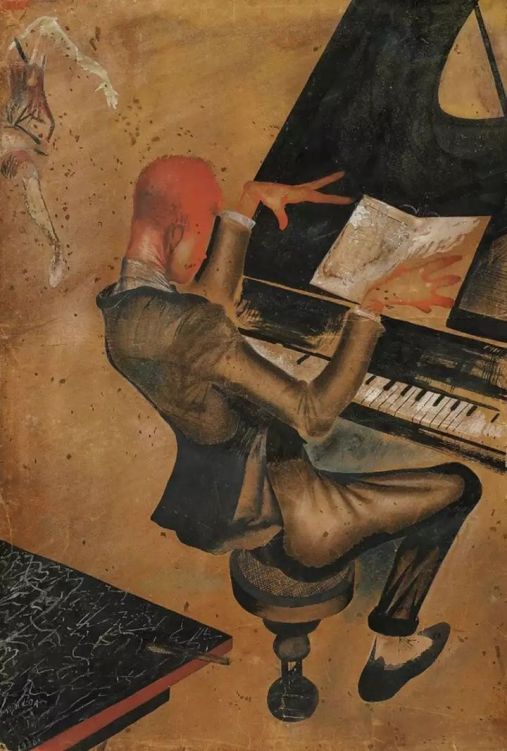
(ENG below) Today I introduce you to a Moscow artist of the 1930s, Yuri Pimenov (Yuri Pimenov). The first painting in the gallery—his “calling card”—is “New Moscow” (1937). However, it merely opens the series. Seven years later, Pimenov painted “Frontline Road,” in which, according to some art critics, the same young woman is depicted. Another appears sixteen years later.
One might wonder, what should an artist do, having found his creative path after all the hurdles and earned fame? Yuri Ivanovich behaved unconventionally: he began destroying all his previous paintings in his possession, and even took home museum pieces he had created, promising to return or bring new ones, and destroyed those as well.

In the end, many of his paintings remain only in photographs…

Similar posts are grouped under the tag #artrauflikes, and on beinginamerica.com in the “Art Rauf Likes” section, all 126 are available (unlike Facebook, which forgets about nearly half of them).

(ENG) Today, a Moscow artist of the 1930s, Yuri Pimenov. The first painting in the gallery, his “calling card,” is *New Moscow* (1937). Yet this work merely opens the series. Seven years later, Pimenov painted *Frontline Road*, in which, according to some art critics, the same young woman appears.

One might think that an artist who has found his creative path after all his struggles and gained renown would settle into his success. But Yuri Ivanovich took an unconventional route: he began to destroy all his earlier works that he still possessed. He even reclaimed pieces from museums, promising to return or replace them with new ones, only to destroy those as well.

As a result, many of his paintings now exist solely in photographs…

Posts like this are grouped under the hashtag #artrauflikes, and all 126 can be found on beinginamerica.com in the “Art Rauf Likes section (unlike Facebook, which tends to overlook almost half of them).

Decoding Betteridge’s Law of Headlines | November 03 2024, 21:12

Today I learned about Betteridge’s Law of Headlines: the rule that posits “If a headline ends with a question mark, the answer is ‘no’.” This law is named after British journalist Ian Betteridge who mentioned it in 2009, though the principle itself has long been in existence. The gist is that if the publisher was confident about a positive answer, they would have phrased it as a statement rather than a question. By framing it as a question, they dodge the responsibility for its accuracy. This sets up automatic expectations for the reader based on the article’s headline, functioning as positive feedback, and headlines are now phrased in this manner not because there’s some psychological explanation, but because it has become customary that a question in the headline implies an unconventional “yes” answer.

I hope I’ve saved you time on reading pre-election articles.

Discovering Sergey Minaev: A Treasure Trove of Engaging YouTube Content | November 03 2024, 15:54

For some reason, Sergey Minaev was on some kind of gray list for a long time, but I’ve started listening to him and I must say, he has some really cool content on YouTube. I would even say one of the best, by my standards. There’s a great series called “Personalities,” where they fascinatingly narrate the biographies of famous people. Just yesterday, I binge-listened to episodes about Margaret Thatcher, Churchill, Bunin, Gagarin, and Clinton->Lewinsky. There’s also a decent series “Simple Things” where they talk about a single thing, like perfume, fur, money, or coal. From the historical series, I enjoyed watching the story of the BCCI bank, which became famously embroiled in a major scandal involving money laundering, financing terrorism, and fraud, leading to one of the biggest banking collapses of the 20th century. The average video lasts about an hour and the content is generally optimized for listening without a screen, which is very convenient in the car. Overall, Minaev has now moved into my very white list, worthy of a recommendation on Facebook (something I rarely do).

Unveiling a Lost Chopin Waltz: Discovery, Recording, and Mystery | November 01 2024, 14:52

So, here Chopin has released a new single.

This year, in the New York library and the Morgan museum’s vault, a manuscript of a previously unknown waltz was found—short and likely unfinished. After thorough analysis, experts concluded that it indeed belongs to Chopin, identified by his handwriting, specific features, dating, etc. Chopin has roughly 250 works and up to 28 waltzes, of which only nine were published; the rest were lost or destroyed, making this newly discovered piece incredibly rare.

The unsigned waltz was never officially acknowledged by Chopin, remaining unpublished and out of the public eye. Little is known about its origin and its possible acquisition by A. Sherrill Whiting Jr., the director of the New York School of Interior Design. From there, a close friend, Arthur Sacks, bought the piece from Whiting’s wife, Jean, and donated it to Morgan in 2019. It has only recently undergone expert examination.

Lang Lang recorded and posted the performance.

https://youtu.be/Poq0VrCF2vo?si=cD8zAyGbG36UW3c_

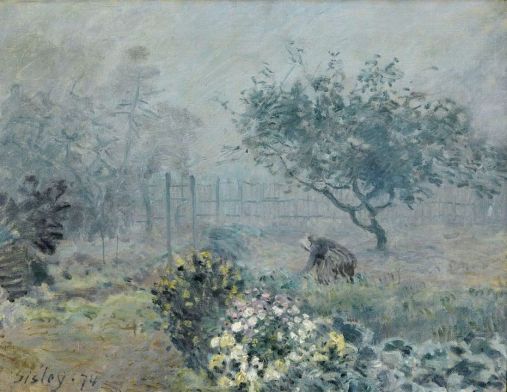
Celebrating Alfred Sisley: From Obscurity to Renowned Impressionist | November 01 2024, 03:42

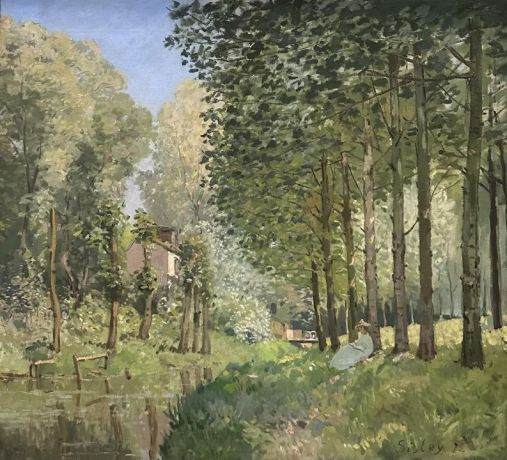
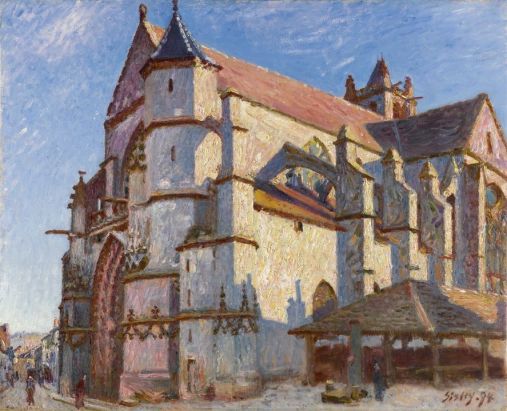
Today, let’s talk about Alfred Sisley, who would have turned 185 yesterday.

Unappreciated in his lifetime, Sisley has since become a symbol of Impressionism, though he faced countless hardships during his life. He joined the ranks of artists whose talents were only recognized posthumously.

Sisley was friends with other Impressionists, including Monet, Pissarro, and Renoir, and participated in the earliest Impressionist exhibitions. Yet, his works rarely sold. Art dealers, such as Durand-Ruel, tried to support him with modest stipends, but his art never brought him wealth. Poverty shadowed him to the end, and he relied on the kindness of friends and the occasional buyer.

Over time, Sisley’s health declined, and he grew more reserved. While his peers gained fame, he remained in obscurity. His long-awaited solo exhibition in 1897 ended in disappointment—none of his works sold.

Sisley died in abject poverty from throat cancer, just months after losing his wife. Ironically, only a year after his death, his painting Flood at Port-Marly (1876) sold to Isaac de Camondo for 43,000 francs—a sum that could buy several houses in smaller towns or a fine home in Paris—more than Sisley had earned in his entire life.

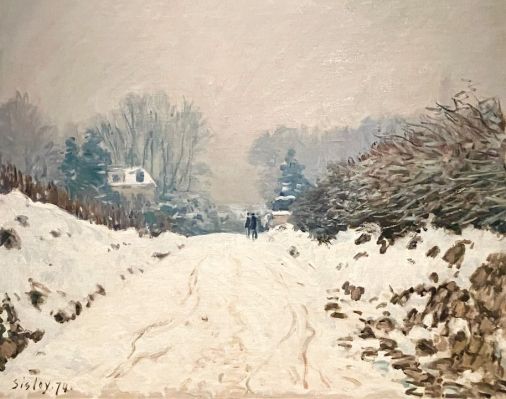
After his death, interest in his work surged, with paintings that once fetched nearly nothing now selling for tens of thousands. In February 2008, Snow at Louveciennes (1878) sold at Christie’s in London for £3.7 million, or roughly $7.8 million.

Posts like this can be found under #artrauflikes, and all 125 are available on beinginamerica.com in the “Art Rauf Likes section—unlike Facebook, which often overlooks nearly half of them.