
Barely didn’t carry a snake home from the market

Barely didn’t carry a snake home from the market
What a cool international airport in Toronto! Just like a fairy tale. It has now taken first place for me, pushing Dubai’s airport out. The only downside is that there’s no subway to the Toronto airport. Only buses and taxis.
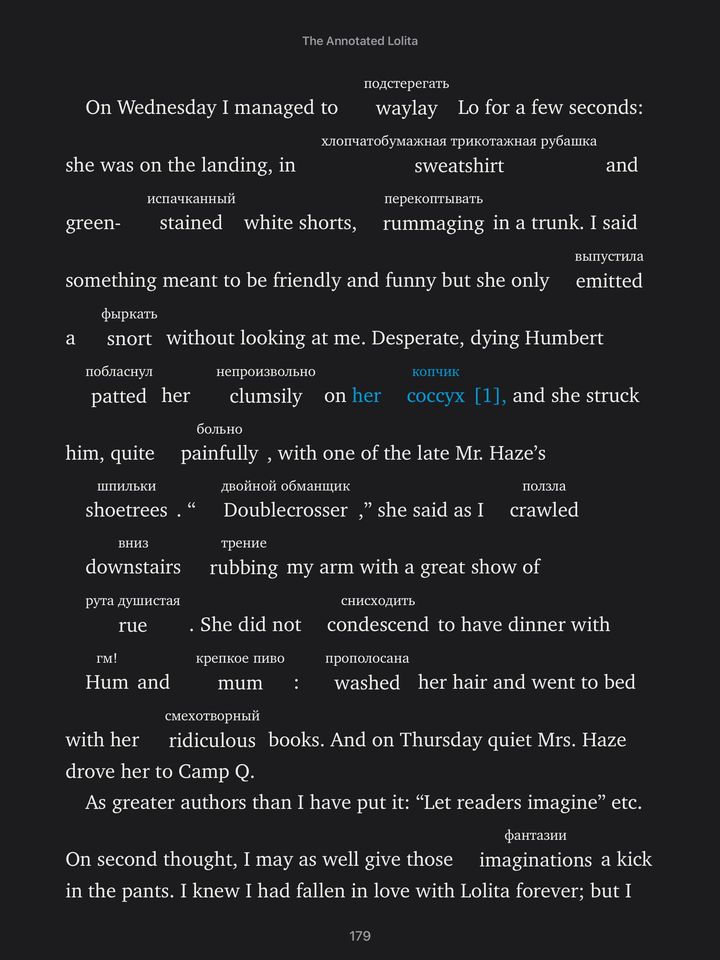
I have enhanced my EPUB converter for reading complex English literary texts. In the previous version, I used to send chapters to ChatGPT, asking it to translate (in brackets) the difficult words. I was asked in the comments how the difficult words are determined. In general, after having read the first quarter of the book this way, I realized that not all difficult words are considered difficult by ChatGPT, including some obviously complex ones, which it doesn’t translate.
Ultimately, I made a new version. Visually, it differs in that translations now appear above words. This arrangement does not break the sentences into pieces like when the translation was in brackets. But that’s not all.
I have changed the method for identifying “difficult words requiring translation.” It now operates with a list of 300,000 words based on their frequency of use in the English language. The first 3.5% of this frequency-sorted list (determined empirically) are now considered simple and do not require translation. The rest do. Technically, I also have a difficulty group for each word rated 1-30, but unfortunately, I cannot highlight them in colors in Books.
Then, the word needs to be translated into Russian somehow. To avoid using LLM for this, I found Müller’s dictionary with 55,954 words. The word that needs translation is put into its normal form and searched in the dictionary. If found, the first definition from the dictionary is taken. Unfortunately, the first one is not always correct, but it works most of the time. If Müller’s dictionary does not have it, the system moves to LLM. Here, I have two implementations – using local LLAMA3 and using OpenAI. The local one is obviously slower and the translation quality worse, but it is free. There is a separate system that checks what LLAMA3 has translated and makes it redo it if it returns something inappropriate (e.g., too long or containing special characters).
In addition, for LLM-based translations, the system is provided with more context — the sentence that contains the word to be translated. This makes the translation closer to the text. There are still minor flaws, but they are generally livable.
However, even with all this, the translation via LLM is of low-quality. Ideally, additional dictionaries should be connected so that if a word is not found in Müller’s, other dictionaries are tried, and only then, if still not found, would we use LLM. I’ve already acquired one and will be experimenting.
If the system tags too many obvious words, I can adjust a coefficient, and the frequency group from which words are not translated will be larger, and surely these obvious words will stop being translated. Of course, there are always “rare” words that do not need to be translated because their translation is obvious. But it’s not easy to teach the script to recognize such instances; it’s easier to just leave it as it rarely happens.
Next, the translation is displayed above the word. For Books, this also involves some complex maneuvers, but it eventually worked on both iPad and laptop. Unfortunately, for the phone, it needs to be done slightly differently, so the book version for the phone and the version for iPad/computer will be different. But this doesn’t really bother me much, what’s the difference.


Yuki has switched into “uuuu” mode again. The previous instances were –
* March 15, 2022,
* October 27, 2022,
* February 2, 2023,
* April 1, 2024, lasting four days.
Behavioral changes during this period include:
1) Suddenly, he likes to walk. Usually, he doesn’t. Despite having constant access to the yard, he specifically requests a walk. He might approach the door and knock on it with his paw. Normally, at the word “walk,” he scurries to the third floor.
Now, he watches your mouth when you speak to him. He constantly waits, anticipating it might be an invitation to go for a walk. He pounds on the window with his paw (see video in the comments).
2) On walks, he sticks his nose into the grass every five minutes, and it’s quite a task to pull him away. Usually, this seldom happens, but now it’s all the time.
3) He might sit and watch the sunset for half an hour. What goes on in his little head, who knows. Oh, and yes, he howls.
4) Unstable appetite. If you put meat on top of his food, he doesn’t even look at it. However, if somehow a small piece of meat is swallowed, he will likely finish the rest. But this change isn’t pronounced, as he’s usually not very greedy for food. He’s eaten just the bare minimum all his life.

Just had a conversation with a friend about the American accent.
I want to share what I’ve come to realize over time: don’t sweat the accent, but gradually learn to make fewer pronunciation errors. Correcting an accent is very tough (it requires years of work with a speech therapist), while pronunciation mistakes usually get fixed in the process of communication, provided you don’t ignore them.
To leave no doubt that correcting an accent is difficult and that its presence generally bothers no one (and often even pleases some), here are a couple of examples familiar to many just from “Mimino”:
– Frunzik Mkrtchyan. Remember, “I have such a personal dislike for the victim, I can’t even eat”?
– Vakhtang Kikabidze. Remember, “Hello! I want Larisa Ivanovna!”?
In the US, one can recall Arnold Schwarzenegger and Salma Hayek. Speaking of Schwarzenegger, it’s quite funny. Initially, he was considered for dubbing the Terminator in German – his native language, but after the auditions were “cut off” because his rural accent sounded very comical coming from a futuristic robot, and eventually, some German voiced the Terminator. But no worries, the grandpa made it to governor, and in 2023 became the Director of Action at Netflix.
A simple rule: what (#1) and how (#2) you say something is far more important than how you pronounce it. Clearly, you need to produce sounds more or less correctly and learn to pronounce them more or less accurately (like bare/bear/beer/peer and similar), but it’s far more crucial to be able to convey thought in “large units”, structurally, clearly, without “fluff” and stumbles.
P. S. A good video on the subject by Virginia Bēowolf in the comments
 Hi, I'm Rauf Aliev.