Aimee Erickson’s Iceberg Principle in Painting | November 08 2024, 02:39

Today — Aimee Erickson (Portland, Oregon, b. 1967). The first painting in the gallery is her self-portrait. Her work is truly remarkable. In literature, there’s a concept called the “iceberg principle,” introduced by Ernest Hemingway. Gertrude Stein advised him on this technique, something along the lines of, “describe a little, but leave most of it beneath the surface. Let the viewer draw their own conclusions.” Aimee’s paintings embody this approach, and I absolutely love it.

Similar posts are tagged with #artrauflikes, and you can find all 128 of them on beinginamerica.com under the section “Art Rauf Likes (unlike Facebook, which forgets or skips nearly half of them).

The Fabrication of Poet James Clifford | November 04 2024, 15:33

This is an excerpt from the poem “Square” by English poet James Clifford, translated by Vladimir Livshits. Clifford was a man with a remarkable destiny, crushed in the vices of two world wars. He was born on the eve of World War I, in 1913 in London, and died in 1944 while repelling a German tank attack in the Ardennes.

Paradoxically, the legacy of the young English poet was better known in the Soviet Union than in his homeland. While in England they asked, “Who is Mr. Clifford?”—in the USSR, his new poems were regularly published from the mid-sixties onward. Thanks must be given to his translator—Vladimir Livshits. He was the first to translate into Russian the famous, seemingly familiar lines from “Retreat in the Ardennes”: “There were five of us left. In a chilly dugout. The command had lost its mind. And was already fleeing.”

But Livshits didn’t just translate these lines; he practically “sanctified” them, because James Clifford, the young English poet who fell in 1944 while repelling the German attack, was for Livshits not just a translation subject but also his own creation. The real James Clifford, who supposedly was born in London, lost his parents early, and was raised by a grandfather—a connoisseur of English and Scottish folklore—never actually existed. Following Walter, Livshits repeated: “If Clifford did not exist, it would be necessary to invent him.” And he invented him.

For decades, Livshits published his own poems in the Soviet Union, presenting them as translations of the non-existent English poet James Clifford.

(taken from the video “Armen and Fedor,” “Comrade Hemingway: How the USSR reforged the novel ‘For Whom the Bell Tolls’?”)

This is how you hack the system 🙂

* * *

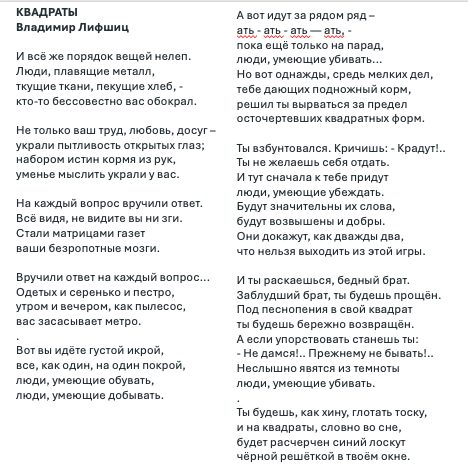
SQUARES

Vladimir Lifshits

.

And yet the order of things is absurd.

People, melting metal,

weaving fabric, baking bread—

Someone has shamelessly robbed you.

.

Not just your labor, love, leisure—

They stole the curiosity of open eyes;

Feeding truths by handfuls,

They robbed you of the ability to think.

.

For every question, they handed an answer.

Seeing all, you see nothing at all.

Your unquestioning minds

Have become matrices of newspapers.

.

They have handed an answer for every question…

Dressed both drab and colorful,

Morning and evening, like a vacuum cleaner,

The metro swallows you up.

.

Here you go, dense as caviar,

All cut from the same cloth,

People who can shoe,

People who can procure.

.

And here they go, row upon row—

March – march – march — march,

So far only for parades,

People who can kill…

.

But one day, amidst the trivial affairs,

Feeding you crumbs,

You decided to break out

From the tiresome square forms.

.

You rebelled. You scream: “They steal!”—

You refuse to comply.

And first, those will come to you

Who know how to persuade.

.

Their words will carry weight,

They will be exalted and kind.

They will prove, as twice two,

That you cannot leave this game.

.

And you will repent, poor brother.

Misguided brother, you will be forgiven.

To chants, you’ll be gently returned

Back to your square.

.

And if you persist:

– I won’t give in!.. No going back!…

Silently, from the shadows

Will come those who know how to kill.

.

You will gulp your despair like henna,

And on squares, as if in a dream,

A blue patch will be lined

With a black grid in your window.
Decoding Betteridge’s Law of Headlines | November 03 2024, 21:12

Today I learned about Betteridge’s Law of Headlines: the rule that posits “If a headline ends with a question mark, the answer is ‘no’.” This law is named after British journalist Ian Betteridge who mentioned it in 2009, though the principle itself has long been in existence. The gist is that if the publisher was confident about a positive answer, they would have phrased it as a statement rather than a question. By framing it as a question, they dodge the responsibility for its accuracy. This sets up automatic expectations for the reader based on the article’s headline, functioning as positive feedback, and headlines are now phrased in this manner not because there’s some psychological explanation, but because it has become customary that a question in the headline implies an unconventional “yes” answer.

I hope I’ve saved you time on reading pre-election articles.

Discovering Sergey Minaev: A Treasure Trove of Engaging YouTube Content | November 03 2024, 15:54

For some reason, Sergey Minaev was on some kind of gray list for a long time, but I’ve started listening to him and I must say, he has some really cool content on YouTube. I would even say one of the best, by my standards. There’s a great series called “Personalities,” where they fascinatingly narrate the biographies of famous people. Just yesterday, I binge-listened to episodes about Margaret Thatcher, Churchill, Bunin, Gagarin, and Clinton->Lewinsky. There’s also a decent series “Simple Things” where they talk about a single thing, like perfume, fur, money, or coal. From the historical series, I enjoyed watching the story of the BCCI bank, which became famously embroiled in a major scandal involving money laundering, financing terrorism, and fraud, leading to one of the biggest banking collapses of the 20th century. The average video lasts about an hour and the content is generally optimized for listening without a screen, which is very convenient in the car. Overall, Minaev has now moved into my very white list, worthy of a recommendation on Facebook (something I rarely do).

Unveiling a Lost Chopin Waltz: Discovery, Recording, and Mystery | November 01 2024, 14:52

So, here Chopin has released a new single.

This year, in the New York library and the Morgan museum’s vault, a manuscript of a previously unknown waltz was found—short and likely unfinished. After thorough analysis, experts concluded that it indeed belongs to Chopin, identified by his handwriting, specific features, dating, etc. Chopin has roughly 250 works and up to 28 waltzes, of which only nine were published; the rest were lost or destroyed, making this newly discovered piece incredibly rare.

The unsigned waltz was never officially acknowledged by Chopin, remaining unpublished and out of the public eye. Little is known about its origin and its possible acquisition by A. Sherrill Whiting Jr., the director of the New York School of Interior Design. From there, a close friend, Arthur Sacks, bought the piece from Whiting’s wife, Jean, and donated it to Morgan in 2019. It has only recently undergone expert examination.

Lang Lang recorded and posted the performance.

https://youtu.be/Poq0VrCF2vo?si=cD8zAyGbG36UW3c_

Celebrating Alfred Sisley: From Obscurity to Renowned Impressionist | November 01 2024, 03:42

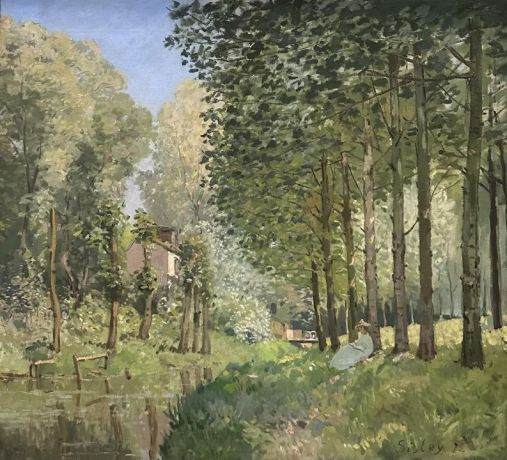
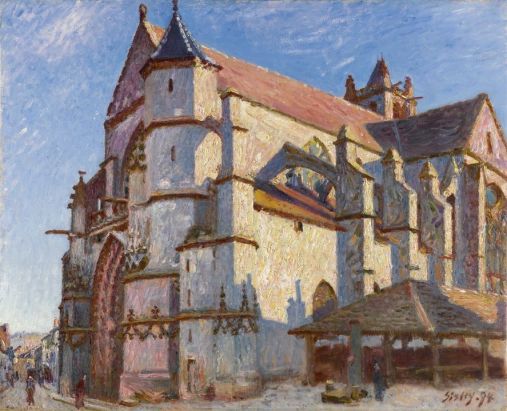
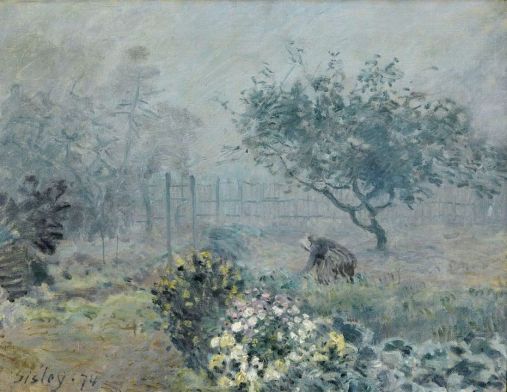
Today, let’s talk about Alfred Sisley, who would have turned 185 yesterday.

Unappreciated in his lifetime, Sisley has since become a symbol of Impressionism, though he faced countless hardships during his life. He joined the ranks of artists whose talents were only recognized posthumously.

Sisley was friends with other Impressionists, including Monet, Pissarro, and Renoir, and participated in the earliest Impressionist exhibitions. Yet, his works rarely sold. Art dealers, such as Durand-Ruel, tried to support him with modest stipends, but his art never brought him wealth. Poverty shadowed him to the end, and he relied on the kindness of friends and the occasional buyer.

Over time, Sisley’s health declined, and he grew more reserved. While his peers gained fame, he remained in obscurity. His long-awaited solo exhibition in 1897 ended in disappointment—none of his works sold.

Sisley died in abject poverty from throat cancer, just months after losing his wife. Ironically, only a year after his death, his painting Flood at Port-Marly (1876) sold to Isaac de Camondo for 43,000 francs—a sum that could buy several houses in smaller towns or a fine home in Paris—more than Sisley had earned in his entire life.

After his death, interest in his work surged, with paintings that once fetched nearly nothing now selling for tens of thousands. In February 2008, Snow at Louveciennes (1878) sold at Christie’s in London for £3.7 million, or roughly $7.8 million.

Posts like this can be found under #artrauflikes, and all 125 are available on beinginamerica.com in the “Art Rauf Likes section—unlike Facebook, which often overlooks nearly half of them.

Enhancing an EPUB Converter for Complex Texts | October 30 2024, 22:46

I have enhanced my EPUB converter for reading complex English literary texts. In the previous version, I used to send chapters to ChatGPT, asking it to translate (in brackets) the difficult words. I was asked in the comments how the difficult words are determined. In general, after having read the first quarter of the book this way, I realized that not all difficult words are considered difficult by ChatGPT, including some obviously complex ones, which it doesn’t translate.

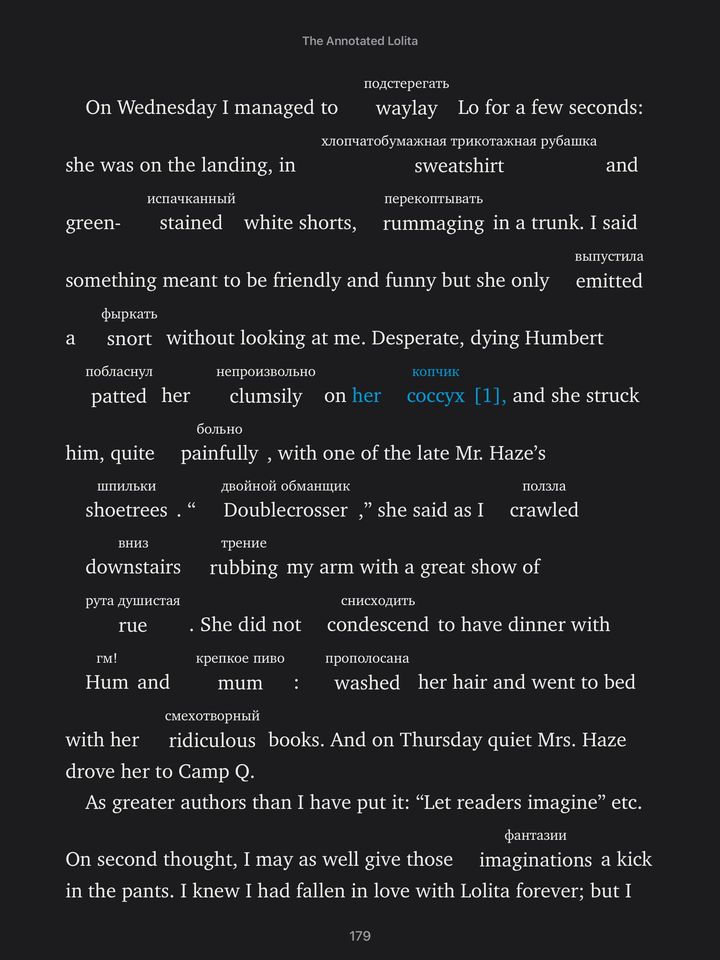
Ultimately, I made a new version. Visually, it differs in that translations now appear above words. This arrangement does not break the sentences into pieces like when the translation was in brackets. But that’s not all.

I have changed the method for identifying “difficult words requiring translation.” It now operates with a list of 300,000 words based on their frequency of use in the English language. The first 3.5% of this frequency-sorted list (determined empirically) are now considered simple and do not require translation. The rest do. Technically, I also have a difficulty group for each word rated 1-30, but unfortunately, I cannot highlight them in colors in Books.

Then, the word needs to be translated into Russian somehow. To avoid using LLM for this, I found Müller’s dictionary with 55,954 words. The word that needs translation is put into its normal form and searched in the dictionary. If found, the first definition from the dictionary is taken. Unfortunately, the first one is not always correct, but it works most of the time. If Müller’s dictionary does not have it, the system moves to LLM. Here, I have two implementations – using local LLAMA3 and using OpenAI. The local one is obviously slower and the translation quality worse, but it is free. There is a separate system that checks what LLAMA3 has translated and makes it redo it if it returns something inappropriate (e.g., too long or containing special characters).

In addition, for LLM-based translations, the system is provided with more context — the sentence that contains the word to be translated. This makes the translation closer to the text. There are still minor flaws, but they are generally livable.

However, even with all this, the translation via LLM is of low-quality. Ideally, additional dictionaries should be connected so that if a word is not found in Müller’s, other dictionaries are tried, and only then, if still not found, would we use LLM. I’ve already acquired one and will be experimenting.

If the system tags too many obvious words, I can adjust a coefficient, and the frequency group from which words are not translated will be larger, and surely these obvious words will stop being translated. Of course, there are always “rare” words that do not need to be translated because their translation is obvious. But it’s not easy to teach the script to recognize such instances; it’s easier to just leave it as it rarely happens.

Next, the translation is displayed above the word. For Books, this also involves some complex maneuvers, but it eventually worked on both iPad and laptop. Unfortunately, for the phone, it needs to be done slightly differently, so the book version for the phone and the version for iPad/computer will be different. But this doesn’t really bother me much, what’s the difference.

Exploring the Evolution of Typewriters and Their Impact | October 29 2024, 01:17

I just found out that IBM used to manufacture mechanical typewriters, which a) had a Backspace key b) featured a moving print head.

The 1984 model is called IBM Correcting Selectric III. It has an intriguing way of deleting a letter – it strikes the paper with a special adhesive tape that removes the ink without a trace.

Interestingly, in 1976, the USSR developed a keylogger for American typewriters and somehow installed them in the typewriters at the US Embassy. It is reported that many secrets were uncovered this way.

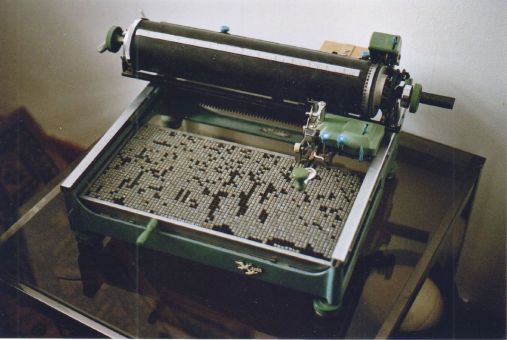
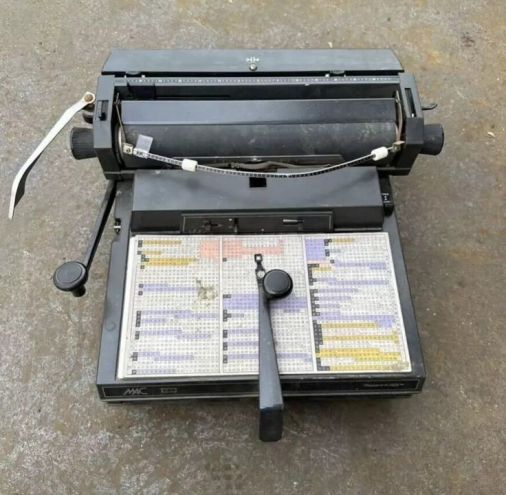
I was also curious about how they managed with this in Japan and China. Their typewriters don’t have a thousand buttons. Believe it or not, they have a single button. But. A thousand squares where they aim the “sight”. Well, I mean, there are different kinds, also like usual ones, but there are models where it’s like this (attaching a few photos). There is even a model with a cylinder that holds 2400 Japanese characters, and you need to rotate and shift the cylinder for each character. I’ll leave a video in the comments. A very elegant engineering solution.

Moreover, in 1947 in China, the Mingkwai typewriter was invented and released, which theoretically allowed typing up to 90,000 characters at a speed of 50 characters per minute. Imagine what an engineering feat that was for the time. You press a key – nothing happens, something clicks inside the typewriter. You press a second time – something else clicks, but this time options that meet the criteria set by those two presses appear on the screen. And the third press essentially selects one of these characters. Meanwhile, the screen… what screen in 1947… It was a window through which characters from a large set were displayed. One character – three presses.

Only today did I realize that the Shift key is called Shift because it physically shifted the basket on typewriters. And while I’m at it, I’ll write about the Return or CR key – carriage return (known as Enter), which is so named because it physically returned the carriage to the beginning of the line. And the underscore (_) was invented to underline previously typed words.

It’s also interesting that the QWERTY layout was dictated by the need to spread frequently consecutive characters further apart to prevent the levers from crashing into each other during fast typing.

My introduction to typewriters in childhood, it seems, began with electric ones, although, of course, I also typed on mechanical ones. Interestingly, Friedrich Nietzsche’s encounter with the typing machine also started with electric ones. I read that he had the first shrivekugel.

In New York, I once saw a store (the only one I know of) that still trades typewriters.

Another interesting fact: when Edwin Hunter McFarland was developing a typewriter for Thailand, he ran out of keys for two consonants (“ฎ” and “ฅ”), and ultimately they disappeared from the language.

Also interesting is that the record for typing speed of 216 words per minute was set 78 years ago by Stella Pajunas-Garnand on a typewriter. In 2005 Barbara Blackburn came close (212 wpm), and in 2019 Anthony “Chark” Ermolin broke the record (233 wpm). Interestingly, such championships are organized by the company daskeyboard, I have two keyboards from them at home and am thinking of buying a third (by the way, has anyone bought one recently?)

In the comments, links to various things from ^^^^

Diane Leonard | October 28 2024, 16:31

Today’s feature is the American impressionist painter Diane Leonard (b. 1949). Mothers, children, the sea, umbrellas, sunshine. It’s interesting how, for many artists, the journey to their style is nowhere to be found online. It’s as if they’ve spent their entire lives painting these same umbrellas, seasides, and families. But life doesn’t work that way. Marketing, however, thrives when an artist has a recognizable style. By the time you turn 75, only the works that support auction sales make it to the web—everything else stays hidden. As a result, we often see only a few paintings, and they tend to look similar. And that always leaves you wondering: what are we not seeing?

Posts like this are tagged under #artrauflikes, and you can find all 123 of them on beinginamerica.com under the “Art Rauf Likes” section (unlike Facebook, which forgets—or buries—nearly half of them).