January 10 2024, 11:33

24 years ago in Russia, payment cards already existed and I was working at a processing center. Quite an interesting experience. There’s virtually nothing on the topic when you google it, so it’s worth leaving it here for posterity.

This was around 1998-1999. Times were tough, as they say, although everything seemed to breeze by for me. An RGRTA student, dorm life, guitar, beer, parties. Somehow, I ended up working as an engineer at KB Stankobank, in the UnionCard processing center. The setup was this: there were about 50 retail points accepting UnionCard. Additionally, there were about 20 companies (factories), where such cards were used to pay salaries or part of them (“payroll project”). Otherwise, they’d receive nothing or get paid in factory products. And I did everything there—from touring the factories explaining from rostrums why and where they could buy food with this piece of plastic. I visited stores explaining to cashiers how to accept these cards and set up terminals. And in our office, servers stood along the wall, and every so often, something needed to be done on the consoles. The servers ran something under Novell Netware (By the way, the company’s name Novell was suggested by the founder’s wife, who mistakenly believed that “Novell” meant “new” in French).

So, the scheme was like this. A customer comes into a store with a card. The cashier calls the call center number. Well, not so much a call center as just dialing our office, where two girls worked. The cashier reports the card number and the amount. The girls confirm that there’s enough balance. The cashier sells the product, and the girls mark it as sold. There were also “slips” and an “imprinter.” Basically, an imprinter is a plastic contraption into which the card and a “carbon copy” slip were inserted, and with a swish-swish, the card number was printed under the carbon copy. The embossed card number is still seen on cards today, although probably no imprinters exist anywhere. The transaction is marked as pending, and then the bank waits for the slips from the stores. Once a slip arrives, the pending transaction becomes complete. At least 50,000 cards were issued.

Essentially, the store sells, say, conditional eggs and bread to a person, and the bank becomes indebted to the store for the eggs and bread. This is where a company called FPK Invest comes into play. Owning everything from a security firm to media assets, this company would supply stores with, say, flour to cover the debt. They traded this flour for machines. And those machines were provided by the very factories that would have liked to pay their workers with them, but since the machines were heavy, workers resisted. Indeed, happiness for everyone. This was called “mutual offset.”

Union Card, despite its foreign name, was a project of the Samara company “Processing Center Union Card.” At one time, many banks were part of the network, and ours was one of them. Later, they were bought by “National Credit Cards,” and then merged with China’s UnionPay. In short, it’s gone into the past. Hardly anything can be googled from the 1999 version anymore.

January 09 2024, 17:53

I regularly visit contemporary art museums in every city where they are present, and each time I see almost 100% of the exhibits made for aliens. I always thought it might wear off over time, that familiarity would do its job. Not a bit. There probably exists some gene, the carriers of which see beauty in it.

Meanwhile, on Instagram, say, contemporary.painting, every other post is cool. Why do museums show one thing while Instagram shows another? Only Instagram is free, but the museum costs 22 dollars.

January 09 2024, 12:33

I am currently reading an interesting book by Ed Yong, An Immense World: How Animal Senses Reveal the Hidden Realms Around Us. It is about the senses of animals, more precisely, about the organs of these senses and how animals perceive the world. For me, the book is full of intriguing facts and discoveries.

The author starts by noting that every animal has its own “sensory bubble,” Umwelt. This term was introduced by Jakob von Uexküll in 1909. Essentially, it’s exactly how they feel the world around them. We see colors, smell scents, and hear sounds differently than other animals, and this difference isn’t measured just by a simple more-or-less scale, but rather as a complex concept. For example, in 1974, Thomas Nagel released the article “What is it like to be a bat?”. Just imagine how the world around us would look if our sensory organs were replaced with radar, allowing us to see scents and hear the direction of the faintest sounds with precision to the degree.

In the chapter about olfaction, the author describes a dog’s nose. In fact, not only dogs—almost all animals see the world through their noses much more clearly than we do. It turns out that the air inhaled through the nose goes into a separate chamber. A wet nose captures molecules from the air with mucus, which then are sent to this chamber for analysis. When humans breathe, the air is inhaled and exhaled through the same “ventilation” channel. For dogs, for instance, it’s different. Their nostrils can function independently from one another. Inside the nasal cavity, special membranes separate the nasal passage into two distinct channels. The first channel is used for breathing, the second—for the operation of olfactory receptors. Furthermore, dogs exhale not just through their nostrils but through special slits located on the sides. Then the air turns and pushes a new air batch back into the nose. Ultimately, a dog analyzes a continuous stream of air, which it also actively pushes through such a configuration. That is, when a dog exhales, it simultaneously inhales as well. This can continue for up to a minute. Not quite like us.

The “sensors” in the nose are long neurons that look outward from the nose on one end and into a part of the brain called the olfactory bulb on the other. Ours are poorly developed, but in animals with keen olfactory senses, they are much larger, as is the number of these neurons in the epithelium and their diversity.

It turns out that some snakes manage to be undetectable even to animals for whom scent is everything. This applies to the rattlesnake, for example. Dogs, mongooses, and meerkats simply cannot sense it. However, if it sheds its skin, they can smell the skin. Apparently, snakes have somehow learned to trick the olfactory system of mammals.

It turns out that out of 15 odorants, humans outperform dogs in detecting five, including β-Ionone (scent of cedarwood) and amyl acetate (scent of bananas). Also, humans are better than dogs at distinguishing certain scents (meaning, both feel them, but humans don’t confuse them while dogs do).

Or for instance, Carvone – caraway, dill, mandarin, orange. It exists in two isomeric forms (mirror images, same atoms), and its enantiomers smell differently: S(+)-carvone defines the scent of caraway and dill seeds, while its mirror isomer, R(-)-carvone, smells of spearmint (acute mint). This proves that humans have chiral scent receptors. It gets even more complicated with mixtures. A mixture of A and B can smell entirely different than A or B individually.

Then these receptors in the nose, they are generated from genes. There’s the OR7D4 gene, which creates a receptor that reacts to androstenone – what sweaty socks and body odor after a run smell like. For most, this scent is unpleasant. But there are some who have a slightly different version of this gene, and for them, androstenone smells like vanilla. Of course, this is hereditary. And that’s just one example. You can imagine how many similar situations there are with other genes. It turns out that we literally “see” the world differently in terms of scents. What one describes as the smell of sweaty socks might seem to another as the smell of vanilla, and if he has never smelled vanilla, he too will call it the smell of sweaty socks, until he encounters vanilla.

It also turns out that the best sniffers are elephants. Apart from the fact that their trunks are structurally better, there are more receptors and a healthy olfactory bulb. Lucy Bates describes an experiment where she took a bit of soil with remnants of their urine from behind a herd of elephants and transferred it hundreds of meters ahead on the herd’s path. Depending on whether it belonged to them, other elephants, or the same herd, the reaction was different. If it belonged to others, they simply walked on and did not notice. But if it belonged to one of them, the elephants were astounded, unable to understand how it could possibly be. It’s like if in our world, you entered a door on the left and came out of a door on the right. They couldn’t understand how the scent could be ahead when they were coming from another direction. The experiment also describes how an elephant can understand that out of a group of scientists who arrived in cars, there’s one newcomer, and he is in the third car on the back seat. It needs to approach him and smell.

Moreover, much is described about the olfaction of birds. Previously it was thought that they had none. Moreover, it turns out the ocean consistently emits a certain scent – dimethyl sulfide, a gas from plankton. And various oceanic birds use this scent pattern – which is plus or minus the same – for navigation.

It turns out that snakes cannot taste or smell with their tongues, but with their quick movements of the forked tongue, they take air samples and send them to the vomeronasal organ (or Jacobson’s organ) for analysis. This organ, by the way, is also present in dogs. With my Yuki, it’s very noticeable when he uses it, and when it’s the nose. Snakes do the same, only unlike dogs, they don’t have another olfactory organ. And we don’t have a vomeronasal organ.

January 09 2024, 11:40

Before my next trip to Starbucks Reserve for coffee, I googled their logo. It turns out that Starbucks originally had a logo with a two-tailed mermaid with a belly, hairy hand, and, excuse me, with breasts. Then they styled it, grew the hair, but it still turned out to be somewhat odd. In the second picture, I suggest my own logo for Starbucks. I think it more fully reflects the name.

January 08 2024, 12:09

Here is my brief video review, probably of the coolest and largest coffeehouse in the world. This is Starbucks Reserve. The coffee there is obviously very tasty, just like everything else. I think they definitely don’t skimp on coffee, as the whole four-story gig probably operates at a major loss, and it’s by design. By the way, it’s a big question why Starbucks in the USA needs to invest in advertising. At the airport and in any small town, there are queues from morning that last half an hour, while alternative coffee shops operate with much shorter lines or none at all. But, probably, working on the brand image today ensures sales in the years to come.

January 07 2024, 13:32

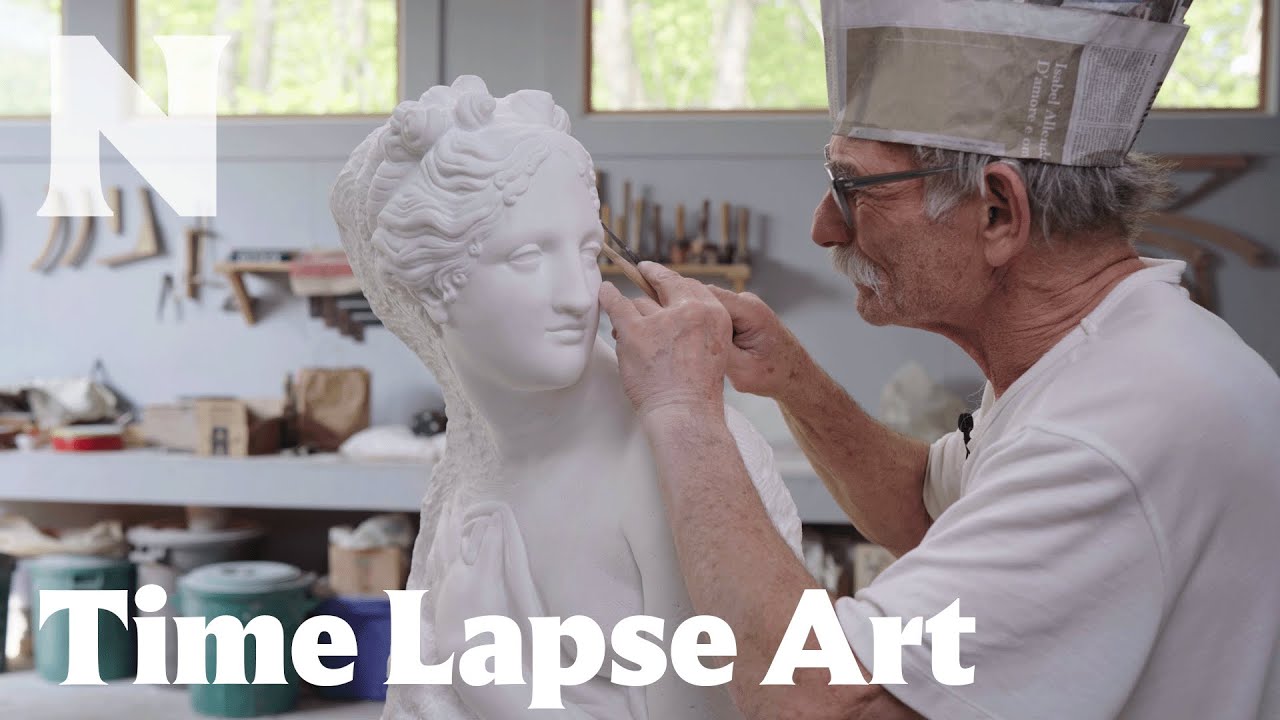
I’ve always been fascinated by how sculptors work. I am currently at the Canova: Sketching in Clay exhibition in Chicago, and there’s this short film playing amidst Canova’s sculptures. Found it on YouTube. In it, American sculptor Fred X Brownstein demonstrates the entire process of creating a replica of Canova’s Venus from sketch and clay model to plaster cast and marble. Quite mesmerizing.

January 07 2024, 08:39

Is there such a service where you enter a hotel, and it shows a price chart throughout the year, from which you can draw various conclusions like when it’s peak and off-peak seasons, how often the price drops, and whether it’s the right moment to book now or better to look for something else?

And the same thing for airplane tickets.

It would also be great to leave a request “I want to stay at this hotel, but not for more than $150”. Or for this destination, but I want to pay no more than $200 for tickets. And leave the dates open. And as a guarantee for the purchase, I’d place a hundred dollars on deposit. I can withdraw it with a 30-day notice. Let the service gather such requests and negotiate with the hotels

January 06 2024, 22:44

I recently started reading a very captivating book by Ed Yong, An Immense World: How Animal Senses Reveal the Hidden Realms Around Us (in Russian translation – Необъятный мир: Как животные ощущают скрытую от нас реальность). I want to summarize each chapter on Facebook to get a better grasp of the subject. Also, as a side effect, to entertain people, although I am doing this more for myself 🙂

I’ve just got hooked on a topic, and went online to dig up details. The topic is – why are there so few blue creatures? There are many red, yellow, brown ones, but few blue ones. It turns out, it’s even more interesting—there are practically no animals with blue pigment. But it’s curious that it’s not “none,” but “practically none”. Interestingly, the same nearly holds true for green.

Let’s start with what a pigment is. Pigments are substances that physically absorb certain wavelengths of light and reflect others, which determines their color. For example, a pigment absorbing red and green light will appear blue. But most likely all the blue you see on animals is not the result of blue pigment. It’s the result of a special physical structure of the surface. These structures are microscopically small and manipulate light through diffraction, interference, and scattering. As a result, the color appears bright and sometimes changes depending on the viewing angle. For example, peacock feathers do not contain blue pigment, but thanks to microscopic structures, they reflect blue light. Pigments work through chemical composition, while structural colors through the physical structure of the surface.

So, everything that comes to mind as blue—butterflies, peacocks, birds like blue jays, blue spiders, blue sharks—none of them have blue pigment. But there are interesting exceptions. For example, the butterfly obrina olivewing has a natural chemical blue pigment in its wings.

You might ask, what about blue eyes? The trick is that blue eyes don’t really exist. Generally, humans have several important pigments that mix to give new colors. For instance, the main pigment, melanin, determines the color of the eyes (and skin, and hair). It comes in two main types: eumelanin (which can be black or brown) and pheomelanin (which gives reddish-yellow hues). So, blue eyes are those without any melanin. The blue color of the eyes is formed by a combination of structural color and the absence of melanin pigment in the front part of the iris. Here, a phenomenon known as Rayleigh scattering also plays a role, which also accounts for the blue color of the sky. The light scatters in the tissues of the iris, with shorter waves of light (blue and green) scattering more than longer wavelengths (red and green). By the way, it participates in the green color of the eyes too. Humans and animals do not have green pigment. The green color in animals is often the result of a combination of yellow pigment and blue structural coloring. In other words, almost all natural life primarily consists of a combination of black/brown/reddish-yellow (melanin), red (hemoglobin), yellow-orange (carotenoids, bilirubin). That’s why earthy paints—sienna, umber, ochre—are often used in portraits. Speaking of carotenoids – flamingos are actually born gray, but because they eat small red crustaceans containing carotenoids, they acquire a pink color.

Speaking of beautiful butterflies. It turned out that butterflies actually barely see each other as we see them. I mean, they almost don’t see everything clearly. Unlike the human three-color retina (blue, green, and red cones; plus rods) and honeybees (ultraviolet, blue and green photoreceptors), the retina of butterflies usually has six or more classes of photoreceptors with different spectral sensitivities. I attached a picture from the book—how a flower with a butterfly on it map butterfly sees a reed bunting and a Eurasian blackbird. There are convincing reasons to believe that butterfly vision is almost non-existent. But what they do have is very, very specific and probably just one component of the olfactory picture of the world. So all this beauty on their wings—it’s not even for each other. It’s sort of a side effect. That is, evolution selected for large spots, but all sorts of small patterns just went along for the ride.

Oh, also about the perception of colors. I attached a picture of how the Himba people of African ethnicity perceive colors. They don’t immediately notice the blue square on the right side, because their language uses the same word for blue and green. But they have no trouble distinguishing the square encircled, because from childhood they are trained to discern this difference and they have two words designating them in their language.

Anyway, if you’re interested, I’ll keep writing stuff like this. It’s quite simple for me to do, and generally interesting to Google more about what I’ve read than the book goes into.