
The best thing to do when someone asks, “Can you play the piano? Play something!”
I’ve been listening to Hayato Sumino for the past two hours. His concert Rhapsody in Blue (Gershwin’s) is wonderful!
https://youtu.be/pHlqEvAwdVc?si=zpqqnKTugC-l5Fvn
The best thing to do when someone asks, “Can you play the piano? Play something!”
I’ve been listening to Hayato Sumino for the past two hours. His concert Rhapsody in Blue (Gershwin’s) is wonderful!
https://youtu.be/pHlqEvAwdVc?si=zpqqnKTugC-l5Fvn
Today, I was reading about dissonances and decided to see if there are any compositions where dissonances are deliberately used as the main material. And I stumbled upon György Ligeti’s Atmosphères.
Listen, it’s very unusual and hardly resembles music at all. He used something called micropolyphony, creating dense webs of chromatic notes moving at different speeds and at various distances from each other.
If you feel like you don’t understand such music and don’t find this assembly of sounds beautiful, imagine instead of an orchestra playing it with solemn faces, a Stanley Kubrick film, for example. Suddenly, everything falls into place.
About a week ago, when I watched The Shining, the first thing I texted a friend was, “Notice that there’s no music in the film,” to which he replied that there is, but it’s so well made and integrated that you don’t notice it. Actually, The Shining has a very cool soundtrack, very well-selected.
So, specifically, this composition Atmosphères (as well as parts of Lux Aeterna, Requiem, and Aventures) was used by Kubrick in his 2001: A Space Odyssey. Another piece, Lontano, was used in The Shining. And Musica ricercata was used in Eyes Wide Shut. By the way, Musica ricercata is quite good; I’ll drop a link in the comments.
In the Mozart opera “All Women Are the Same” or Cosi Fan Tutte by the Royal Opera House production, the one on the right (Dorabella) resembles Mizulina, while the one on the left (Fiordiligi) resembles Skabeeva.

For those who play the piano — there’s a very interesting channel by Mikhail Proshin. I’ve been subscribed to it for a long time and have watched it for a while. Just to illustrate, here’s the latest from it. It has a good thought, very applicable to my case.
He talks about the trap of professional musicians (I am not professional). They often perceive music “top-down”– as a finished product that must be reproduced. This results in them giving equal attention to both fundamental and minor elements, which can hinder development and prevent enjoyment of the process. Amateurs, lacking high technical skill, simplify compositions, accompany themselves, and focus attention on the basic structures of music. This allows them to quickly understand and internalize musical basics, such as chords and harmonies, and use this experience in other songs. A professional might learn 100 songs without truly understanding them, and quickly forget many — this is just my case. An amateur, by simplifying 100 songs, can extract fundamental knowledge and build their own style on this basis, experiencing 100 situations of success.
The idea is that playing “from the bottom up” is not just simplification, but a conscious process that helps better understand music and enjoy performing it. A very good thought, indeed.
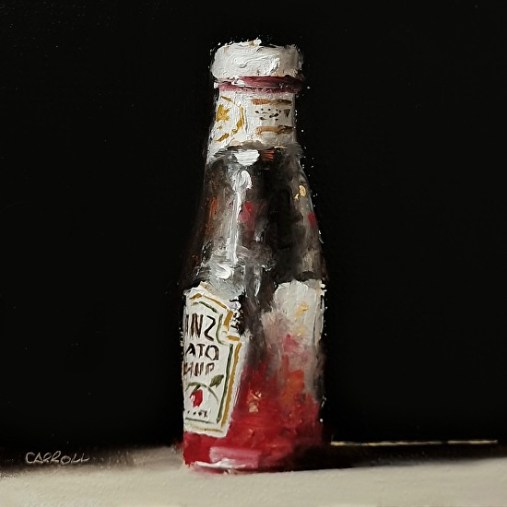
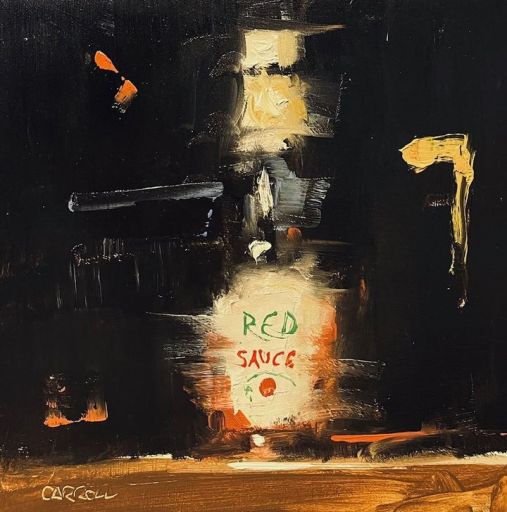
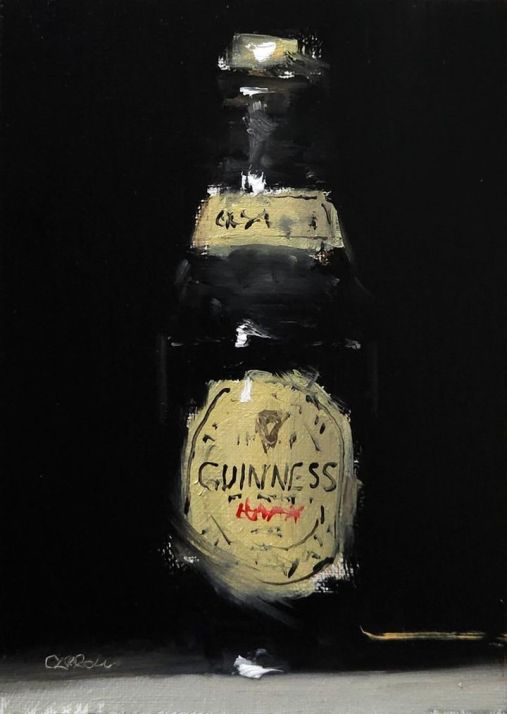
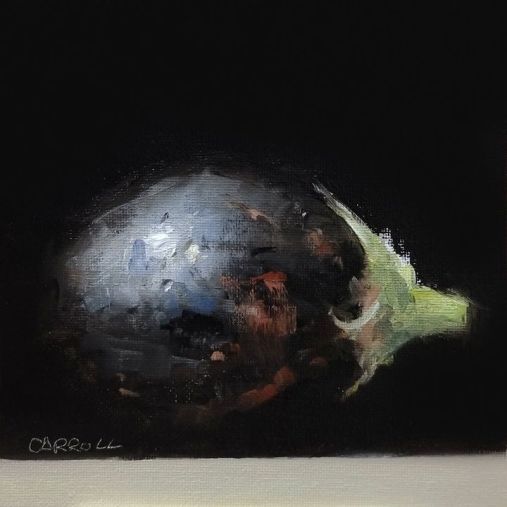
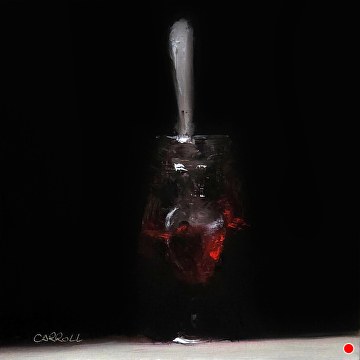
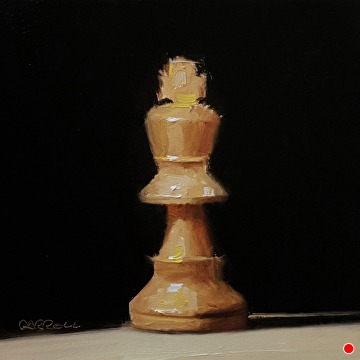
Today, I’m sharing these thematically simple paintings by British artist Neil Carroll. All of them depict everyday kitchen objects against a dark background. Many of them are quick sketches that likely didn’t take more than a few hours to complete (most canvases are about 6″ wide, give or take). Carroll has turned this into a steady output, and online, you can find hundreds of similar yet distinct paintings, all in a consistent style.
But what’s so special about a painting of an apple or a lemon with side lighting on a dark background? It’s practically a student sketch—art school students have piles of these gathering dust in the back of their closets. Yet once you gather at least a dozen of these uniform paintings, completed in a consistent style, suddenly it becomes “real” art, and the artist is lauded for carving out their niche. The more they create, the more firmly they establish themselves in that niche.
It’s a straightforward formula: do what you enjoy and remain consistent in your style and approach.
What’s also captivating about such simple objects is observing how the artist distinguishes between what’s significant and what’s not. I’ve gleaned a lot of intriguing insights and now I’m eager to try my hand at it having studied Carroll’s techniques. So, expect some ketchup paintings from me soon.
Posts like this are grouped under the hashtag #artrauflikes, and all 117 of them can be found on beinginamerica.com in the “Art Rauf Likes” section (unlike Facebook, which forgets—or neglects—almost half).





1) It turns out the MacOS notification sound had a name, and it was Sosumi. It was used from 1991 to 2020, after which it was replaced with Sonumi. There’s a funny story behind the name.
2) These sounds have a creator. It’s Jim Reekes—Apple’s sound designer, and there’s a secret that wasn’t disclosed for about 10 years after his departure from the company.
3) The Beatles are partly the authors of the MacOS startup sound.
Now for the full story. There was a company called Apple Corps, organized by the Beatles. Its logo was also an apple (of course), hence there was a legal dispute with Apple, which ended, as the joke goes, with the agreement “I don’t give loans, and the bank doesn’t sell seeds.” Apple Inc. could use its name but was not allowed to venture into the music industry and use music-related names in its products.
Accordingly, any Apple ventures into music immediately alarmed lawyers from both sides. When it came to creating system sounds, the lawyers tensed up and asked Reekes to first, not use the name “Chime,” and second, please no melodies in the sounds. As a result, operating system sounds like Frog, Funk, Glass, and Hero appeared.
Eventually, Reekes worked hard on the startup sound and created a C major chord.
Reekes assures that while creating the C major chord, he was inspired by The Beatles’ song “A Day in the Life. I don’t know why I’m laughing here.
Returning to notifications. After much deliberation and attempts to find a neutral name, Reekes proposed the playful name “Let it Beep” in the style of The Beatles’ song “Let it Be”, but his colleagues thought it would be hard to accept. When someone suggested such a name would lead to legal disputes, Reekes jokingly replied: “So sue me,” and suddenly realized that this phrase would be perfect for the sound name. Eventually, they decided to rename the sound to “Sosumi. He told his bosses it was a Japanese word having nothing to do with music.
In macOS Big Sur, the original chime was replaced with another, which was named Sonumi. The original name was retained in the first public version of the OS, but later changed to “Sonumi. The sound file itself /System/Library/Sounds/ is still named Sosumi.aiff.
Now, the OS startup sound is completely removed. It seems you can enable it in the settings.

Improvisation by Ellen Alaverdyan from Las Vegas on bass guitar. Everything on her channel is amazing. It’s said that she started playing in April 2020, during the lockdown (hard to believe).
https://www.youtube.com/watch?v=lDrkMNw6Wr0
 Hi, I'm Rauf Aliev.