MRI Musings and Magnetic Mysteries | November 13 2024, 21:50

Today I found myself in an MRI machine, where they scanned my brain. I hope the brain is still there, and I hope the MRI operators didn’t find anything interesting in there.

What else to think about for 45 minutes in this buzzing machine, where you can’t move, but thinking isn’t forbidden?

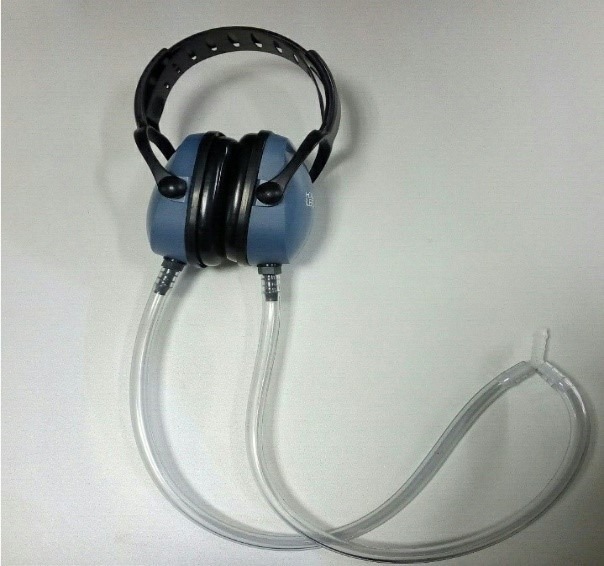
Right, I wondered how headphones could work in an MRI machine, the ones they put on me. Music was playing from them, and occasionally—the voice of the MRI operator. Think about it—in any headphones, there should be diaphragms and magnetic coils, yet inside an MRI coil, none of this can exist. I started to ponder, and if my implants are in order, maybe the headphones could be made from special materials like titanium. In general, I lay there and racked my brain. Eventually, I came to a solution, which turned out to be just that.

A thick hose stretched from the headphones to the machine, and that explained everything. The headphones are just cups with tubes stretching from the headphones to another room where the speakers are located. The sound travels through the tube via air—a very simple solution.

Challenges of Training a Shiba Inu with Unpredictable Eating Habits | November 11 2024, 16:22

This explains why training our Shiba Inu is such a challenge. Food generally doesn’t motivate him. It’s been at least 12 hours since he last ate. We had breakfast long ago, and lunchtime is approaching. And here you are, bringing him warm boiled meat, which generally he likes, but if it isn’t his usual mealtime, he doesn’t understand why he’s been given meat when he didn’t ask for it. And his response is like — what’s this for, just put it in the bowl, I’ll eat it eventually. And it’s been this way all 3.5 years. Moreover, he almost always eats when someone is at home. If nobody’s around, he’d rather sleep. So leaving food for him and going away almost guarantees you’ll come back to find it untouched. Overall, he enjoys tasty food, and when it is indeed time to dine or have dinner, he eats with great pleasure whatever you give him.

In general, when he doubts whether to eat the meat from the bowl or not, and after thinking it over decides to leave, the trick is to pull out a piece of meat and offer it from your hand. If he eats it (and if he’s already by the bowl, he’s more likely to eat from your hand), his decision will likely change. And within a minute, the bowl will be empty.

Or take cheese, for instance. On one hand, when we pour some wine and get a cheese platter to make watching a series or movie more fun, Yuka also comes over to watch the cheese, drooling copiously, ready to eat a kilogram of it at any time. But you need to pour the wine and turn on the projector. If, however, you bring cheese at some random time or anytime outdoors, his reaction to the cheese will be the same as to a stone.

Cinema Ballet: A Stunning Fusion of Film and Dance | November 10 2024, 22:16

This was our first ballet in a cinema, and the experience turned out to be simply stunning. It was very hard not to applaud (the projectionist?). Rich colors, intricate costumes, amazing detail, very good sound, which gave the full feeling of sitting in front of the orchestra pit. Yes, what’s happening on stage is a flat picture, but unlike the static front row at the Paris de Bastille theater, where your eyes are at the level of the performers’ heels, here the best angle is chosen for each scene, thanks to the moving camera. Altogether, a very interesting experience.

The production itself was luxurious. Odette/Odile was performed by Korean Se Yun Park — seemingly the first Asian etoile at the Paris Opera. Paul Marc played the role of Prince Siegfried.

This was a daytime session on the last day, plus ballet in cinema is still not more popular than Marvel comics. There were about ten other people in the auditorium besides us.

Spoiler: Both the prince and the swan end up dying majestically. Poor bird 😢 Right after that, we headed to a restaurant to eat duck.

Incidentally, it turns out that directors choose the ending according to their own taste in different productions. In the 2012 production by the State Ballet of Siberia, Siegfried and Rothbart drown in the lake; in the 2015 production by the English National Ballet, Siegfried’s love breaks the curse and the other swans defeat Rothbart; and in the 2018 production by the Royal Ballet, Siegfried rescues Odette from the lake, but she is already dead.

New Butterfly Species Named by Russian and German Scientists | November 10 2024, 13:48

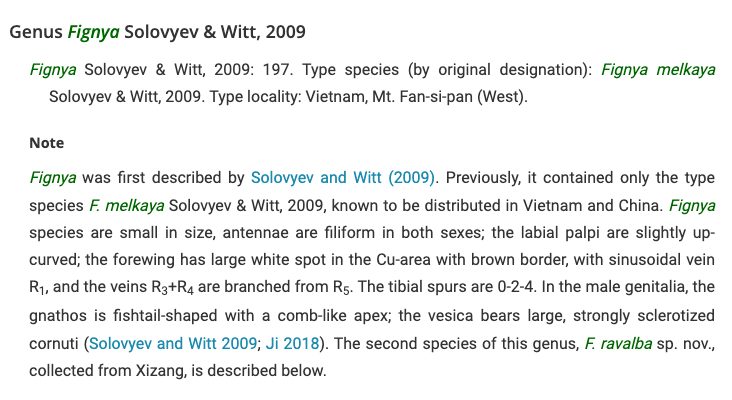
The Ulyanovsk scientist Alexey Solovyev, together with the German Thomas Witt, discovered a butterfly with unusual genitalia and named it Fignya melkaya. It belongs to the slime-lookalikes.

Interestingly, do they also name butterflies after presidents?

Monkeys Released from Research Center During New Presidency | November 07 2024, 13:59

During Trump’s presidency, it was COVID. This time – we’re releasing 40 monkeys from a research center. 🙈🙉🙉🙊🙉🙈🙉🙊🙊🙉🙈🙉🙊🙊🙈🙉🙊🙉🙈🙉🙊🙉🙉🙊🙈🙈🙊🙉🙈🙉🙊🙊🙉🙈🙉🙊🙉🙈

https://www.nbcnews.com/news/us-news/monkeys-escape-alpha-genesis-research-facility-south-carolina-rcna179077

https://www.nbcnews.com/news/us-news/monkeys-escape-alpha-genesis-research-facility-south-carolina-rcna179077

The Fabrication of Poet James Clifford | November 04 2024, 15:33

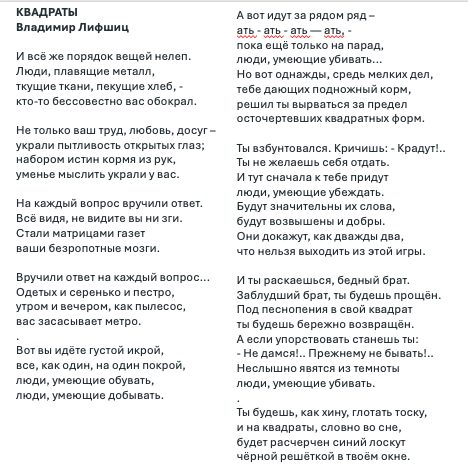
This is an excerpt from the poem “Square” by English poet James Clifford, translated by Vladimir Livshits. Clifford was a man with a remarkable destiny, crushed in the vices of two world wars. He was born on the eve of World War I, in 1913 in London, and died in 1944 while repelling a German tank attack in the Ardennes.

Paradoxically, the legacy of the young English poet was better known in the Soviet Union than in his homeland. While in England they asked, “Who is Mr. Clifford?”—in the USSR, his new poems were regularly published from the mid-sixties onward. Thanks must be given to his translator—Vladimir Livshits. He was the first to translate into Russian the famous, seemingly familiar lines from “Retreat in the Ardennes”: “There were five of us left. In a chilly dugout. The command had lost its mind. And was already fleeing.”

But Livshits didn’t just translate these lines; he practically “sanctified” them, because James Clifford, the young English poet who fell in 1944 while repelling the German attack, was for Livshits not just a translation subject but also his own creation. The real James Clifford, who supposedly was born in London, lost his parents early, and was raised by a grandfather—a connoisseur of English and Scottish folklore—never actually existed. Following Walter, Livshits repeated: “If Clifford did not exist, it would be necessary to invent him.” And he invented him.

For decades, Livshits published his own poems in the Soviet Union, presenting them as translations of the non-existent English poet James Clifford.

(taken from the video “Armen and Fedor,” “Comrade Hemingway: How the USSR reforged the novel ‘For Whom the Bell Tolls’?”)

This is how you hack the system 🙂

* * *

SQUARES

Vladimir Lifshits

.

And yet the order of things is absurd.

People, melting metal,

weaving fabric, baking bread—

Someone has shamelessly robbed you.

.

Not just your labor, love, leisure—

They stole the curiosity of open eyes;

Feeding truths by handfuls,

They robbed you of the ability to think.

.

For every question, they handed an answer.

Seeing all, you see nothing at all.

Your unquestioning minds

Have become matrices of newspapers.

.

They have handed an answer for every question…

Dressed both drab and colorful,

Morning and evening, like a vacuum cleaner,

The metro swallows you up.

.

Here you go, dense as caviar,

All cut from the same cloth,

People who can shoe,

People who can procure.

.

And here they go, row upon row—

March – march – march — march,

So far only for parades,

People who can kill…

.

But one day, amidst the trivial affairs,

Feeding you crumbs,

You decided to break out

From the tiresome square forms.

.

You rebelled. You scream: “They steal!”—

You refuse to comply.

And first, those will come to you

Who know how to persuade.

.

Their words will carry weight,

They will be exalted and kind.

They will prove, as twice two,

That you cannot leave this game.

.

And you will repent, poor brother.

Misguided brother, you will be forgiven.

To chants, you’ll be gently returned

Back to your square.

.

And if you persist:

– I won’t give in!.. No going back!…

Silently, from the shadows

Will come those who know how to kill.

.

You will gulp your despair like henna,

And on squares, as if in a dream,

A blue patch will be lined

With a black grid in your window.
Decoding Betteridge’s Law of Headlines | November 03 2024, 21:12

Today I learned about Betteridge’s Law of Headlines: the rule that posits “If a headline ends with a question mark, the answer is ‘no’.” This law is named after British journalist Ian Betteridge who mentioned it in 2009, though the principle itself has long been in existence. The gist is that if the publisher was confident about a positive answer, they would have phrased it as a statement rather than a question. By framing it as a question, they dodge the responsibility for its accuracy. This sets up automatic expectations for the reader based on the article’s headline, functioning as positive feedback, and headlines are now phrased in this manner not because there’s some psychological explanation, but because it has become customary that a question in the headline implies an unconventional “yes” answer.

I hope I’ve saved you time on reading pre-election articles.

Unveiling a Lost Chopin Waltz: Discovery, Recording, and Mystery | November 01 2024, 14:52

So, here Chopin has released a new single.

This year, in the New York library and the Morgan museum’s vault, a manuscript of a previously unknown waltz was found—short and likely unfinished. After thorough analysis, experts concluded that it indeed belongs to Chopin, identified by his handwriting, specific features, dating, etc. Chopin has roughly 250 works and up to 28 waltzes, of which only nine were published; the rest were lost or destroyed, making this newly discovered piece incredibly rare.

The unsigned waltz was never officially acknowledged by Chopin, remaining unpublished and out of the public eye. Little is known about its origin and its possible acquisition by A. Sherrill Whiting Jr., the director of the New York School of Interior Design. From there, a close friend, Arthur Sacks, bought the piece from Whiting’s wife, Jean, and donated it to Morgan in 2019. It has only recently undergone expert examination.

Lang Lang recorded and posted the performance.

https://youtu.be/Poq0VrCF2vo?si=cD8zAyGbG36UW3c_

Enhancing an EPUB Converter for Complex Texts | October 30 2024, 22:46

I have enhanced my EPUB converter for reading complex English literary texts. In the previous version, I used to send chapters to ChatGPT, asking it to translate (in brackets) the difficult words. I was asked in the comments how the difficult words are determined. In general, after having read the first quarter of the book this way, I realized that not all difficult words are considered difficult by ChatGPT, including some obviously complex ones, which it doesn’t translate.

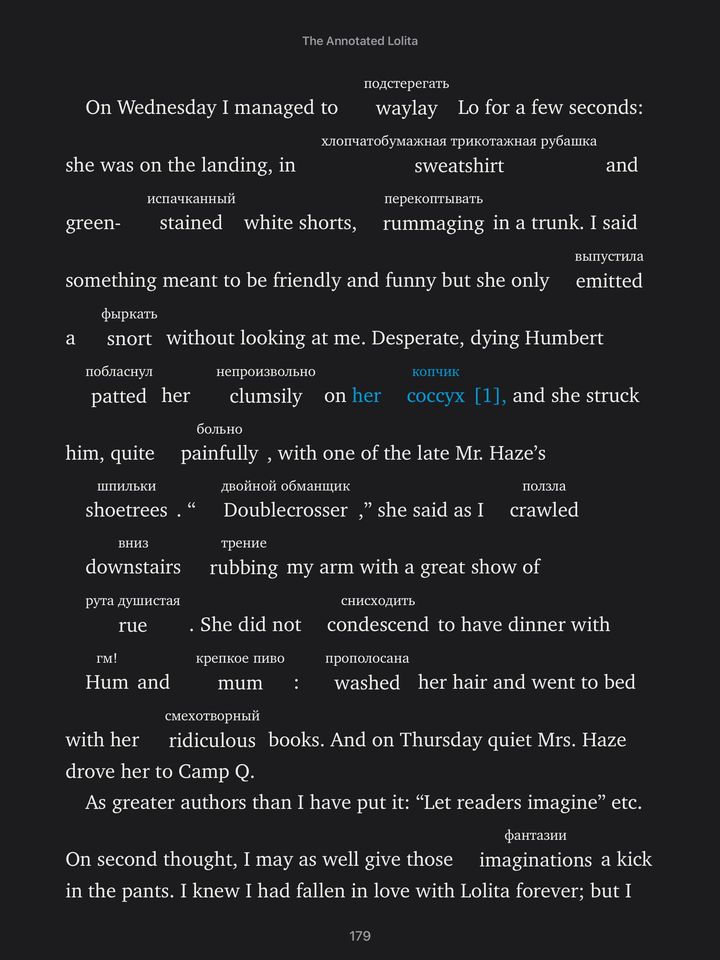
Ultimately, I made a new version. Visually, it differs in that translations now appear above words. This arrangement does not break the sentences into pieces like when the translation was in brackets. But that’s not all.

I have changed the method for identifying “difficult words requiring translation.” It now operates with a list of 300,000 words based on their frequency of use in the English language. The first 3.5% of this frequency-sorted list (determined empirically) are now considered simple and do not require translation. The rest do. Technically, I also have a difficulty group for each word rated 1-30, but unfortunately, I cannot highlight them in colors in Books.

Then, the word needs to be translated into Russian somehow. To avoid using LLM for this, I found Müller’s dictionary with 55,954 words. The word that needs translation is put into its normal form and searched in the dictionary. If found, the first definition from the dictionary is taken. Unfortunately, the first one is not always correct, but it works most of the time. If Müller’s dictionary does not have it, the system moves to LLM. Here, I have two implementations – using local LLAMA3 and using OpenAI. The local one is obviously slower and the translation quality worse, but it is free. There is a separate system that checks what LLAMA3 has translated and makes it redo it if it returns something inappropriate (e.g., too long or containing special characters).

In addition, for LLM-based translations, the system is provided with more context — the sentence that contains the word to be translated. This makes the translation closer to the text. There are still minor flaws, but they are generally livable.

However, even with all this, the translation via LLM is of low-quality. Ideally, additional dictionaries should be connected so that if a word is not found in Müller’s, other dictionaries are tried, and only then, if still not found, would we use LLM. I’ve already acquired one and will be experimenting.

If the system tags too many obvious words, I can adjust a coefficient, and the frequency group from which words are not translated will be larger, and surely these obvious words will stop being translated. Of course, there are always “rare” words that do not need to be translated because their translation is obvious. But it’s not easy to teach the script to recognize such instances; it’s easier to just leave it as it rarely happens.

Next, the translation is displayed above the word. For Books, this also involves some complex maneuvers, but it eventually worked on both iPad and laptop. Unfortunately, for the phone, it needs to be done slightly differently, so the book version for the phone and the version for iPad/computer will be different. But this doesn’t really bother me much, what’s the difference.

Navigating the Complexity of Global Numerical Nomenclatures | October 29 2024, 22:55

Russian TV channels have demanded two undecillion (2*10^36) rubles from Google. But what amused me was something else — technically, Google, or rather Googol, stands for 10^100. So, they’ve got plenty left in reserve.

But it was also interesting to learn that for large numbers there are two different systems of nomenclature. They diverge starting from billion, which in one system is 10^9 (equivalent to a milliard in the other) and in the other system it’s a trillion, which is 1000 times more, and this trillion in the second system means quintillion in the first, and so on, ultimately making the undecillion of the first system equivalent to sextillion in the second. It’s quite a mess, really.

The complexity is further increased by a third variant, called “the first, but not quite” — with the amendment that 10^9 is still considered a milliard, not a billion.

Different countries historically use different scales. The first, which is called the short scale, has primarily been adopted in English-speaking countries. In their scale (thus, ours) — 10^9 is a billion. In the Arab world, it’s generally a milliard (مليار), like in Saudi Arabia, it’s a billion (بليون).

Russia is also among those using the short scale. Hence, they demand an undecillion from Google, not a sextillion.

The second scale, which is long, is used by the Danes, French, Germans, Portuguese, and Spanish. For them, 10^9 is called a milliard with adjustments for pronunciation and grammatical representation in the language.

And then there’s a slew of exceptions, including countries that don’t fit into either of these two “camps.”

But what’s even more interesting is that until 1974, Britain called a billion a milliard, a trillion was known as a billion, and a quadrillion as a billiard. In 1974, they officially switched to the short system.

Canada faces the toughest situation. There’s already confusion with units, and the big number systems add to the mix. Officially, it adopts the short system, like the US, but due to bilingualism (English and French) and significant cultural influence from France, you might occasionally encounter the long system. South Africa is in a similar situation.

Curiously, the only article about this in French (and it says sextillion!) — is from RT. No one else in the world seems to care about this stuff. 🙂